Tuesday, January 7, 2014

Postcard from Northern California

Spectacular. Breathtaking. Heavenly.

Each of these adjectives aptly describes the vistas that I was fortunate
enough to gaze upon just last week. It was only a day or two earlier that I
was communicating from home with several Sierra Club leaders from the San
Francisco Bay area about the most rewarding nearby hikes. I judiciously
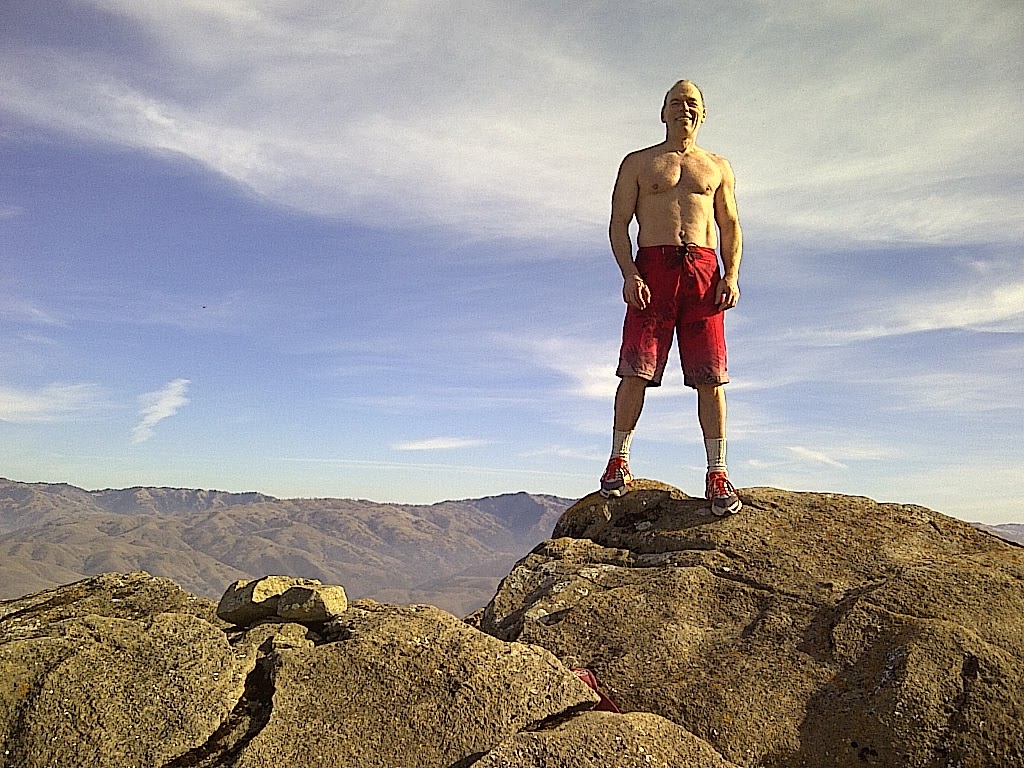
decided that the trail to Monument Peak would satisfy my need to breathe
some fresh California air from on high. As my recent thirst for hiking has
not yet been quenched, this choice turned out to be prescient. Unlike the
hiking at home, the Monument Peak trail, typical in the region, is
completely barren. Barely a tree to be seen, very few bushes, hardly a
clump of grass. No, we are not above the tree line, but the mountains that
define Silicon Valley, the Diablo Range to the east and the Santa Cruz
mountains to the west receive almost no rainfall, especially and
unfortunately in the past year. And so I am walking steeply uphill on a
dusty mountain side, under a warm, thirsty sun, always watching out for the
elusive mountain lion. He is here I am warned, ready to pounce on me from
that cliff above or from behind that next turn in the dirt path. My
longtime local friend, Dano, tells me that in all his years of hiking and
biking the surrounding mountains, he's only once seen a mountain lion, and
then from the safety of his car. Still, I am wary. The hike is steep. After
passing by dozens of cows grazing the rocky lower slopes in search of
moisture, I find myself above the layer of smog that blankets the valley
below. The bare, caramel-coloured mountains 20 km across the valley pop up
into sight. Unlike everywhere else I've ever been, the temperature here
climbs with the elevation, from 15C at the base to 23C at the peak. The
view has exceeded any expectations that I may have had. Contoured,
desert-like mountain ranges greet me on three sides, seemingly close by, an
illusion that I've witnessed before. A California condor soars overhead and
I wonder if it, too, has climbed 2,600 feet, like me, to gaze out at the
world in wonderment.

When you visit Northern California, remember this secret that I will now
share with you: the Elkhorn Slough (pronounced 'sloo') at Moss Landing. It
is here that I rented a kayak and paddled from the marina into the slough,
a swamplike area six miles long. There are over 300 species of birds living
here, some of them rather large such as pelicans and egrets. It is amusing
to watch the pretty, white terns circling above until spotting their fishy
prey straight below. Then they assume a streamlined shape by tightly
tucking in their wings and diving straight down into the chilly water,
emerging seconds later with their catch in their little beaks. But I am
saving the best for last: there are hundreds of seals, otters and sea lions
who live here in the protected slough. The sea lions are huge and scary but
they seem to spend their lives basking in the sun on the shore, bellowing
loudly and pushing each other around. Near them, it always smells like the
insides of a fish market. The seals are always swimming around, surfacing
anywhere at random, often surprising the paddlers nearby. It seems we
frighten them, too, as they quickly dive again only to resurface elsewhere.
But it is the sea otters who make me laugh out loud. They float around on
their backs, often in pairs, busily licking their little hands or munching
on whatever they are clutching. Otherwise they tease each other with their
otter games, like 'Guess Who is Behind You' or 'Tag, You're It,' I decide.
We are not supposed to paddle within one hundred feet of the animals, but
if they surface right next to my kayak, why not watch their frolicking from
up close and enjoy the entertainment?

I am sure you know that California is home to the famous redwood forests,
majestic trees that grow over many centuries straight up for a hundred feet
and more, often five to ten feet in diameter at the base. What you may not
know is that there are some redwood forests where you are welcome to cycle
through. One such place is the Nisene Marks state park, its southern
entrance located in the town of Aptos. Not just any park, the cycling trail
climbs 2,600 feet over nine miles. It doesn't sound like much of a
challenge but there are long stretches where many cyclists (the untrained,
I conclude) are forced to walk their bikes for it is nearly too steep to
pedal. Imagine yourself pedaling uphill for two hours with no respite. It
becomes easy to overlook the startling fact that I am winding my way uphill
in the midst of millions of immense trees. They block any chance of
sunlight from sneaking through the many branches and leaves far overhead.
It is only after 90 minutes that a break in the route brings me to a ledge
where riders can stop and gaze out for the first time at the forest below
and to the sea miles away to the southwest. As with my hike two days
earlier, it is much hotter here than at the mountain's base, a conundrum
still unsolved. Lest you think it is all hard work, remember that what goes
up must come down. Luckily, the brakes worked as advertised as it would be
deadly to attempt the return downhill without them functioning properly. If
you don't care to bike, many folks were simply walking along the same trail
as far as they cared to enjoy the majesty of the redwoods forest at a
slower pace.

Whether your pace is faster or slower, I wish you a happy, healthy and
sporty 2014.
Barry... the triathlete!
Sunday, December 1, 2013

Postcard from ADK - Cascade and Porter mountains

The morning was crisp, so crisp that my lungs burnt from breathing in the
fresh air too deeply. And the snow was dry and squeaked beneath my hiking
boots, tickling the soles of my feet. But the sun, the sun shone
brilliantly on my face, warming it ever so slightly from the frigid breeze
that greeted all early risers on this glorious day.
And thus I started my first hike of the winter at the base of Cascade
Mountain off of route 73 in New York state.
The trees, of course, are bare, their leaves have already changed to
brilliant reds and yellows a month or more ago and then blown free of their
branches in the brisk autumn winds. They lie now buried beneath the carpet
of snow that beckons to me this morning.
The trail is narrow, winding and steep: my favourite! At times, it is
obvious that the hiking trail is actually a creek, with cascading frozen
waterfalls acting as slippery steps allowing me to climb upwards. Makes me
wonder if this is how the mountain earned its name.
Some of you may not know that hiker, climber and skier aficionados all
affectionately call The Adirondacks, ADK, for short. There are apparently
46 high peaks in the ADKs and its every hiker's goal to summit them all. On
completing the 46th, there must be a celebration of sorts shared at the
peak by all those who have accompanied the champion, champagne or
chocolate-covered strawberries perhaps.
Now this may seem somewhat ridiculous as reaching the very highest and most
difficult ADK peak is akin to a walk in the park compared to The Annapurna
or Everest regions of Nepal or the 46 highest peaks within, say, The Alps.
But as the old saying goes, beggars can't be choosers, so the local
challenge and tradition remain just that and thus an accomplishment worth
celebrating. (I must inform you, for the sake of all ADK enthusiasts, that
some of the peaks require a 15-hour round-trip excursion -- ill-advised for
the beginner!)
Before long the forest of deciduous trees has been replaced completely by
conifers, their branches laden with snow. The trail narrows and ratchets
continually, left here, right there, so that one cannot see the trail at
all beyond a few metres ahead. It is a little magical -- it doesn't take
much to imagine that Bilbo Baggins's front door may be carved into that
immense boulder over there!
After an hour and a half we suddenly emerge from the forest onto a steeply
sloped clearing which provides us with a spectacular view of the valleys
below and the neighbouring mountains as far as the horizon and beyond. The
sky is brilliant in its blue-within-blueness and free of clouds treating us
to unparalleled visibility of 30 or 40 kilometers! I am elated! Really! So
much so, that I did in fact run back down a half-kilometer or more to
encourage the slower hikers in our group to hustle with the promise of the
awaiting vista.
I turned my back on the panorama and continued upwards, back into the now
stunted thicket of trees. Before long, I emerge for there are no more trees
at all. The final 500 metres is bald rock, with windswept, smooth surfaces,
seemingly piled on top of each other by a giant toddler. It is windy, cold
but I am nevertheless in awe of the majesty that surrounds me. Unlike other
summits, the absence of trees provides us with 360 degrees of all natural
beauty. Remarkable that there is no sign of civilisation in any direction
as far as the eye can see! Even stranger, perhaps due to the temperature,
neither a sign of life: not a single bird nor a mouse nor a rabbit. Lots
and lots of rabbit tracks, however, and a leftover carrot or two, but no
sign of the elusive creature.
Here's wishing all your days have their peaks, too!
Barry, the hiker who runs up and the runner who hikes down.
PS. 44 summits to go!
PPS. For the record we all managed to summit next-door Porter Mountain on
the same hike :-)


Sunday, December 30, 2012

Postcard from BC (Postmarked 30 Dec 2012)


Normally when recounting a ski trip, I would enjoy illustrating the rapture of effortlessly skiing down a steep, powdery slope and describe with pride the chain of perfectly formed "S's" left behind in my wake. We skied at Big White this week, it's located in the Okanagan Valley. Yes, thankfully many of the trails are steep and powdery here, too, but what really sets this station apart from the others are its ghosts! You've got to see them to believe them and they are most eerie when viewed while riding the chairs up the mountain. Due to the typical, local weather conditions, the dense fog that often rolls through the valley, the evergreen trees become coated with hoarfrost, which in turn causes all the snow that subsequently falls to stick to the frost. Before long and certainly weeks before our arrival, the trees are each laden with thousands of pounds of thick snow, clumped together in various configurations, often with their weaker treetops curled over with fatigue. As you ride up in the chair 30 feet above the ground, the all-white trees slip by you on the right and on the left, a few at a time, each one looking more human than the next depending on conditions. Some are leaning over seemingly to reach out at you sitting in your chair. Others apparently are chatting amongst themselves, one or two are holding infant ghosts in their arms. As with clouds taking on surreal shapes in the sky, these snow ghosts take shape in our minds as we glide past them on every ride back up to the mountain's summit.

Apparently there is yet another unique experience awaiting the fearless at Big White: a 60-foot tower of ice constructed specifically for climbing, the only such structure in North America. I replace my winter shoes with boots specially outfitted with crampons on the soles, don a helmet and grab a pair of ice picks which I strap on, one to each wrist. All my concentration remains focused on climbing this veritable wall of ice, vertical in its entirety, resembling variegated columns of giant silvery icicles, glittering in the light, yet pocked with crevices and other features which allow me to judiciously plant my boots and picks. I am wearing a harness to protect me in the event that I fall, the 'instructor' below having challenged me to reach the top without once falling or taking a break en route. I accept his challenge and thus all my energy remains focused on where to step up to next and where to reach to plant my ice picks next. It is arduous, I admit, as my forearms become exhausted as I reach the three-quarter point, but my resolve is redoubled and I advance tentatively. There is no resting or stopping and after no more than fifteen minutes in total, I have reached the top, rung the bell, and now enjoy rappelling back down like you've likely seen the Navy SEALS do in the movies.

When visiting Vancouver, if your time is limited, then after cycling the 5km route around Stanley Park, you must take a water taxi to Granville Island, immediately south of downtown. The taxi is tiny holding a dozen people at most, sitting low in the water like a miniature tug boat and piloted by a kid no older than 21. It looks like a toy boat, painted in all the rainbow's colours. Five minutes later we disembark on the Island to find a public market. I am reminded of the Grand Bazaar in Istanbul as here, too, there are dozens of stalls, maybe hundreds, food here and crafts there. The perfume of cut flowers mixes with the sweet smell of powdered sugar and then again with that of freshly baked breads and pies. It is easy to lose oneself amongst the sellers, the shoppers and those that simply meander about, window shopping sans windows. Once tired of the throngs, step outside again and you will likely be entertained by a busker or two, working hard atop a fifteen-foot unicycle or juggling flaming pins to the delight of the crowd.

As 2012 will very soon be extinguished with just a series of delightful memories remaining, I wish you a very rewarding and healthy 2013!

Barry from the West


Saturday, August 4, 2012

Postcard from The Canadian Rockies (Postmarked 04 Aug 2012)


Greetings!

It is the height of summer and I am standing on ice. Very thick ice. Only a thousand feet below me is there solid ground. Did you guess that I am at the Columbian Ice field, walking on a glacier, the Athabasca glacier? It truly boggles the mind to fathom how huge this glacier still is, which has already lost 60% of its volume since first discovered 135 years ago. It continues to retreat 10 metres per year and will likely have melted completely before another 135 years slowly slip by. But today I am standing on ice which goes down for a thousand feet to the ground below. We took a bus tour almost a kilometre up the glacier and then disembarked to walk around on the hard, bluish ice. While there, I managed to fill a bottle with glacial water that was coursing downhill and drank it later in the day, after it had warmed up a little. It is supposedly, mystically, very rejuvenating. You may not recognize me when I return home with a full head of hair!

Understatement of the year: Hiking the Rockies is incredibly exhilarating! 
Some hiking trails follow fast flowing streams, the noisy currents rushing over polished rocks and gushing down mini-waterfalls, the colour of the water white being fed by glaciers melting many miles upstream, carrying dissolved rock flour which gives it its unique colour. Other trails may snake along a mountain ridge, the slope on one side falling steeply several hundred feet below, the bottom invisible due to the thick evergreen forest, no doubt filled with dangerous animals lurking in the shadows. Still others may circle around a chain of lakes whose waters are a rich, otherworldly, aquamarine-turquoise colour and unusually clear all at once. Just the right amount of rock flour dissolved in the lake and only the deepest green hue will get reflected back to our eyes. In all cases, the views change with each minute and are magnificent: nearby mountains grow out of the ground in all directions to dizzying heights, many still dotted with fields of snow or indeed capped completely in snow, and, some with huge, silver-grey glaciers literally stuck to the slopes in precarious orientations. It is obvious why I overhear people speaking in all the world's languages as these are world-class vistas which attract tourists from every country!

Before departing Montreal, I had been reminded by several friends to "remember to wear my bear bells" while hiking in the Rockies. Turns out they do exist -- these $2 trinkets are sold to the tourists (for $10) to be worn on your belt or attached to your backpack while hiking in the wild.
With each footstep the bells jingle and thus alert the nearby bears of your presence.
But I have another theory: they in fact attract the bears and so several tourists are eaten each season, sparing the locals who hike in peace and enjoy the serenity of the parks absent the constant jangling and consequential bear attacks.

And speaking of bears, here is a tip for spotting them in their natural habitat: while driving along the roads in the parks, if ever two or more cars are parked together on the shoulder, simply slow down and pull over as well. What is funny is that often there are so many cars arriving that they are sometimes stopped right on the road, at all angles in every direction, effectively halting all traffic. 
Within a few moments you, too, will be snapping pictures or shooting videos of wildlife. Using this secret technique, we saw elk with huge, almost preposterous antlers feeding on the grass, mountain sheep clinging to rock faces licking at the deposited salts, and black bear families munching on berries just a few metres from the safety of the car. Of course, it is even more exciting to exit the car and venture closer on foot. It's always a good idea to have your escape route in mind as these animals are wild, are fast and are unpredictable, too!

Here's hoping your summer is not too unpredictable nor too wild...

Wild West Barry + Cowgirl Olga
Lake Agnes

Saturday, December 31, 2011

Postcard from Charlevoix (Postmarked 31 Dec 2011)


I understand how it typically takes a full day or even two to shake off the big-city notion of indifference towards strangers once we indeed leave Montreal for our holidays.
However arriving in Charlevoix accelerates the process as you are quickly immersed in a region of the world where everybody cares! Asking a question or small favour of a complete stranger seems to empower him or her with the lucky chance of helping you choose the best restaurant nearby or whatever else it takes to fulfill your request! Then a conversation ensues and you find yourself sharing details of your day's activities and your impressions of the area. Pretty soon it becomes difficult to break away before first becoming Facebook friends. It pays to allow ample time before a rendezvous (or dinner reservation) just in case you end up in conversation with somebody by chance and you can't politely break free.

The 16cm of heavy snow that fell overnight was immediately followed by several hours of rain; finally, near-zero visibility due to fog rendered our first day of skiing a pass. When life gives you lemons... it's time to make lemonade! Here's a tip for you that even most locals here seem unaware of: 5 minutes walking distance from the Chateau Mont Sainte-Anne is the start of a hiking trail that parallels a small river. The path is blanketed in heavy snow with very few footsteps previously tracked. The forest is thick with trees, wet snow clinging to the evergreens and fog hangs eerily in every direction. There appears to be animal tracks scattered about but it's hard to be certain. Suddenly -- yes, suddenly! -- the sound and fury of what turns out to be the very top of a waterfall comes into sight, its water crashing down below onto successive terraces and then into a canyon 300 feet beneath us that had remained hidden until now. There are several hundred slippery, wooden stairs that allow you to precariously descend besides the cascading falls giving many exceptional views of the falling water and spray, the frozen surroundings and ice sculptures that form and re-form with each hour's changing weather. Once at the bottom, the trail meanders aimlessly and once again silently as the roaring falls quickly disappear behind us.

I have heard for many years about Le Massif, the ski centre near Baie Saint-Paul. The entrance to the mountain, the parking area, ticket sales, chalet, etc., is exceptionally at the TOP of the mountain; we ski from there down to the bottom, of course. What I had heard all these years was how surreal the view is from the summit as the ski runs literally descend into the St-Lawrence river which flows by the very base of the mountain. The view of the river is breathtaking, nearly 20km wide at this point, full of ice floes, with the odd cargo ship breaking its way upstream toward Quebec City. The air is so clear today, the sun so brilliant, that the opposite side of the river is easily seen and so, too, are the mountains beyond. Given the bend in the river to the east, I am guessing that we can see at least 50 km downstream from our perch atop Le Massif!

Here's wishing you a happy and healthy 2012 from wherever you may be perched!

Barry -- have snow will ski!

Thursday, May 13, 2010

Postcard from Crete (Postmarked 13 May 2010)


Imagine the scariest road you've ever driven on: it winds its way up the edge of a steep canyon embankment, in a never ending series of S-turns and switchbacks; narrow, often barely wider than your own car, a rocky wall to your right, a void to your left; fallen rocks from the cliff face above are strewn across the surface, or worse, immense boulders not even Atlas could lift; there are no guard rails protecting you from the precipice inches away, (but sometimes you will see an impotent wire fence which may keep a stray goat from falling over,) there are mountain goats everywhere even some lazing on the sinuous road; you haven't seen another vehicle in a quarter-hour but one may loom around the next turn vying for the same precious real estate as are you; don't even think of glancing down, it is ominous enough to look out, away, at the other mirific canyon walls facing you from across the gorge that sinks below, way below.

Welcome to Crete!

Crete is known for its gorges, they are ten or twenty kilometers long, usually running north-south to the sea, very steep and a minimum of 1,000 metres deep. Yesterday I hiked down into the best-known one, Samaria, but due to the late start, only spent three hours trekking. Many people hike the entire 18 km length, a five-hour trek down to the land-locked village of Agia Roumeli and then, after lunch and a swim, must take a boat to another port village and finally a bus back to the start -- an all-day affair. I did meet a quartet of French, who were doing the circuit in reverse, including a nine-hour climb from Agia Roumeli to the top of the gorge! That will be my objective on my next visit, my travel-mate willing!

As treacherous as are the mountain roads is as spectacular as are the Cretan villages. It is a veritable wonder how each seaside village is unique in its character and charm, like how it is said no two snowflakes are quite alike. For instance, Plakias has a boardwalk along the beach separating the tourists into two halves, those that bathe in the sun and water from those that indulge in food and drink in one of the two dozen tavernas lining the narrow beach road. And above them are the 'rooms for rent' which are always easy to spot even in the smallest mountain village. Or, take Hora Sfakion, a huddle of tavernas and cafes, bunched together at the top of a cliff, each one overlooking the same bay below, where colourful, wooden fishing boats sway to the incoming waves on one side and the patrons of the beach play under the sun on the other. One of my favourites, Agia Galini, is only accessible by foot, down steep, winding, whitewashed steps, threading a variety of blue and white-painted tourist shops full of knick-knacks and essentials, too, until at the bottom you see a clutch of tavernas jumbled together, on top of, as well as besides each other, facing the sun and the small, rocky beach at its base. On the other hand, there is Xania, not a village but a city, with its old town defined by narrow cobble stoned alleys, meandering in random directions, containing hundreds of tourist shops built into ancient edifices. All the proprietors speak English and many are outside their stores, smoking and chatting with their neighbours in between customers. All this activity surrounds a semi-circular harbour which is lined with a stone boardwalk and thirty or more tavernas, each one with more or less the same menu of fresh fish, Greek salads, pikilias, always soaked in olive oil. In front of every one is the owner, waving down passersby with quick one-liners, offers for free raki or galaktaboureko, or whatever gesture it takes to earn their business. As everywhere else, the hotels and pensions are upstairs, accessible by a back alley, all with views that spill out onto the bustle below, then the harbour, the time-worn lighthouse and finally to the sea.

Here's hoping the seas are calm in your life, too!

Barry the Greek


Sunday, May 9, 2010

Postcard from Athens (Postmarked 09 May 2010)


What is it that the Chinese are supposed to have said? "May you live in interesting times!"
By now you must have read about, or seen on TV, the demonstrations and riots in Athens. The nationwide, general strike on Wednesday shut down the entire country and resulted in my inbound flight, along with hundreds of others, being canceled. Apparently, it also resulted in three poor, innocent souls dying in a burning building while the crowd outside protested. I did ultimately arrive early Thursday and soon after witnessed the burned-out shell of the five-storey bank in question and the charred remains of a car parked in front. Later, when visiting the Acropolis before sunset we could hear the start of Thursday's demonstrations echoing between the buildings and then up through the smoggy air from Syntagma Square below, a kilometer away. Were there 10,000 or 100,000 people marching, shouting, demanding to have their 2 months of annual vacation pay re-instated, I could not see, I could not say?

Not normally one to shy away from exaggeration and hyperbole, I must admit that the average traveler in Athens is not affected, much less aware of these ongoing, historic events. The cafes and restaurants in The Plaka are still bustling with tourists, drinking ouzo and retsina, which accompany their pikilias and Saganaki shrimp entrees. (What other nation would consider cooking giant shrimps with feta cheese in a tomato sauce?) The bouzouki players and singers continue to entertain and it would seem that the demonstrators know better than to upset the one sure source of foreign currency and so The Plaka is never on the marchers' route.

Hugging the base of the Acropolis's east face, the Plaka is quintessential Athens. A maze of restaurants with tasty traditional food at reasonable prices, all flavours of Greek wine and spirits, and smoking allowed everywhere as here the no smoking laws are flouted with indifference. Every 'taverna' has a stunning box seat view of the Acropolis, which at night is all the more spectacular as the Parthenon is lit up against the black sky. Most establishments offer a rooftop garden but I recommend dining al fresco at street level as all the alleys are closed to cars and the tables from one spot spill over onto those of the next. Here's a tip for your next visit: The best restaurants are the ones on the cross-streets -- these are the alleys paved in stone that climb up steeply towards the Acropolis -- where a party atmosphere prevails.

If you are a graffiti artist, I recommend that you stay away from Athens. Try as I did, I could not find any side of any building, nor fence, nor overpass unblemished by graffiti. The artists must be very frustrated with no fresh canvass available. Across the street from my hotel, the owner was painting over his façade -- I cannot guess why as it unlikely to stay immaculate more than a few days! It is my only disparaging comment about this once-great city, unfortunately the graffiti is ubiquitous.

If you arrive in Athens, but somehow have forgotten your sunglasses, no worries! On every corner, or so it seems, there are African immigrants selling sunglasses, as well as counterfeit Louis Vuiton bags, watches and any number of useless tchotchkas. With tourist high season fast approaching, I can guess that even the cheap, the fake and the pointless will all find willing buyers. Here's hoping that there's nothing pointless taking place in your life...

Yasou!
Barry