I had been looking forward to this day with the excitement of a schoolchild before recess since the middle of February, four months ago.
For unknown reasons that I have yet to determine there are many Via Ferrata routes set up in Andalucía. My best guess is that the oldest and most famous, the Caminito del Rey, which still exists today, may have served as a challenge to the local climbers who possessed plenty of free time, some powerful drilling tools and a need to create something challenging where before there was nothing but rock. I write this because as the hands of fate have decreed, the local guide that I hired two days later to lead me through the magic of the Torcal mountains, was the very same, the one who, along with two friends, in 1997 actually built the Via Ferrata that I was now about to climb. Serendipity comes in many flavours, this time must have been cherry garcia. I had imagined that a provincial or regional government had constructed the Via Ferrata, but I was wrong, at least in this case.
The Torcal mountains, near Antequera, are indeed magical like none other in the world, this because the mountains were eons ago underwater. Not that the sea here had receded, but rather here the mountains rose out of the sea and kept rising for well more than 1,000 metres. Thanks to their long life spent underwater followed by their recent history above sea level and to all the known theories of erosion by rock genre, the resulting formations of rock slabs teetering upon other similar slabs appear amusingly cartoon-like! The vistas, in all directions, nearly defy explanation, where every turn of the head and every step forward present yet another view of improbable juxtapositions of immense pizza pie slices of rock.
I had never hired a guide for a hike previously but we had little choice of accessing the mountains from our home base in Antequera except by minibus. Therefore I hired said minibus, and the guide was included. Another fortuitous decision as the route that he led us on would have been impossible to find without his lead. We walked along unmarked paths often so narrow and so close to the edge of various cliffs that it was simply smart to pretend that it wasn't so! His 'office' was the Torcal mountains, his playground growing up, and it was right next store, a couple of kms away, to where he and his friends decided to build their own personal Via Ferrata nearly 20 years ago!
By now you may be asking what exactly is Via Ferrata. Today it is a challenging climb up mostly vertical rock faces, with many twists and turns thrown in for good measure. Iron 'staples' are secured into the mountain face, spaced apart just enough to make the ascent difficult. These staples stand in for footholds and handholds allowing us to climb. Where there are ledges or cracks in the rock, there are fewer staples if any. All the while we are perched hundreds of metres above the ground far below. Throughout the journey, we are wearing a climbing harness and we are clipped onto a cable running the entire route with a caribiner. If ever one slips and falls, the attached caribiner would limit the fall to a foot or two or three at most. In fact there is little risk of injury, however anyone with a fear of heights or a fear of cliffs would be wise to stay away -- there is plenty of both! There are often other challenges along the route. In ours today we had to zipline across a ravine that revealed a 200 metre drop below our dangling feet. As the zipline was not downhill, one had to pull oneself hand over hand from one end to the other, all the while being suspended by the line. Very scary for some people; in my case: just plain fun! It was ironic however to learn two days later that our hiking guide explained how the zipline is no longer safe, how it needs to be completely replaced, but that the new Swedish owner of that mountain will tolerate climbers but not a repair party. What was scary for some and fun for others was evidently dangerous for all!
The biggest challenge for me today was dealing with the very high winds blowing. While waiting for the zipline to get set up, we all perched on a ledge -- imagine sitting astride a large horse and you'll get the picture -- which dropped precipitously on two sides very far below. Even though we were all clipped in, we were on an exposed peak, and the strong wind nearly blew me off the ledge several times. Of course I would have only fallen a couple of feet, but dangling from a cable, scratched up and possibly upside down wasn't my idea of entertainment.
Apparently the climbers rate the routes, K-1 through K-4; today's was a K-3. I understand the K-4 will have sections under a rock ledge where you are obliged to basically maneuver upside down along the rock ceiling like a spider, from the entry to the exit of the ledge, with just the staples fixed into the ceiling as your guide. Yep, I definitely want that challenge! There are other interesting features, too, elsewhere, like the monkey bridge, where you have to cross a ravine along a bridge made of three wires, one to walk on, the other two for your hands to hang on to. I am uncertain why it is called a monkey bridge, but I can guess having a long tail might come in handy.
Regardless of the various tests of courage, it is always a thrill to simply stop at any point along the route, lean back and gaze at the landscape from high up the face of a cliff, the valley below stretching many kms before another stark mountain obstucts the horizon, the cloudless blue sky uninterrupted by clouds, the sight of a herd of seemingly tiny goats passing below at some random place, the sound of their bells clanging all the way up to my ears and with their requisite shepherd dog keeping them moving along. Once the bells are out of range and between gusts of wind it is eerily silent while resting, giving me pause to reflect on my good fortune to be here at all, to have sought out this excitement far away from home and to look forward to the celebration party that is sure to follow our successful arrival at the summit at some nearby, unknown, secret restaurant in the middle of nowhere that likely does not even exist on TripAdvisor!
Here's hoping that you, too, are from time to time happy to be celebrating something in the middle of nowhere!
Ferrata or Bust Barry.
Thursday, July 7, 2016
Tuesday, July 5, 2016
Postcard from Cordoba - postmarked 27 June 2016
How many times in a person's adult life can you expect to do something completely novel, something never experienced, something imagined but never attempted?
I am not talking about driving a new model car nor dining in a new restaurant. Rather, something that tests one's mettle.
Today I chose to go whitewater kayaking for the first time! No instruction, no course, no YouTube video to guide me through the dos and don'ts.
While the others jumped into the two standard inflated rafts for the planned whitewater rafting adventure, I jumped into a kayak! You probably know that I have kayaked for many years but with precious few exceptions, all my experience has been on one sole lake in the Laurentians: no current, no rapids and certainly no white water!
With a dose of good fortune for me, the whitewater gods created the Rio Genil with many sets of exciting rapids, each set with increasing difficulty as the current flows downstream. I was luckily informed of this in advance so I was ready to be likewise increasingly challenged the whole afternoon. I decided it sensible to try some daring maneuvers early on, to take some risks, because failures and errors at the outset could become lessons learnt for the hardest passages towards the finale. It was a prescient decision.
When I first heard the tumultuous roar of the first set of rapids ahead, my heart started to beat a bit faster; I couldn't yet see what was coming as the river is continually winding with numerous immense trees hanging over the water's edges, completely obstructing the view ahead. We were in a canyon of sorts and the riverbanks were thick with foliage. Many of these trees have broad branches jutting out horizontally close to the surface, probably vying for some of the abundant sunshine streaming down. If I am not careful, the current can drive my kayak along the shore and off comes my head at the next branch! Almost as bad, many of these trees have tentacles which grow off the upper branches hanging straight down into the water; these harmless looking vines are spiked with thorns, ready to rip at your clothing or exposed skin. Please don't ask me how I know these details with such precision!
The cacophony of the approaching rapids is growing in loudness, now I can also feel the booming of the cascading waters and I see the two rafts ahead jerking to the left, then to the right, as their occupants paddle furiously to keep from capsizing. I know I am next, ready or not. I am also cognizant that I took on this challenge willingly, so against any natural tendency to be fearful and anxious, I chose to paddle more assertively, daring the river to control my destiny. My kayak was sucked into the first of several drops in the river, I was being splashed from all sides, soaked from directly ahead as the front of the kayak went underwater repeatedly, the noise was deafening but I screamed, "Si, si" (translation: "Yes, yes, give me your best!" ) and paddled hard to keep my kayak pointing ahead no matter how it was being bashed sideways from the churning, screaming white water.
All this happens fast, very fast, so I slowed down time in my mind to give myself a fighting chance. Soon enough I was again into calmer water and I paddled toward the shore to enter into the countercurrent and relax for a minute, catch my breath and re-evaluate.
I succeeded the easiest of what was to come so I decided to try to turn my kayak perpendicular to the current after the next set of rapids and see how I could control the forces attacking me. This didn't work out so well and I was quickly thrown out of the boat into the freezing cold water. Thanks go to the rafting organizers for the full wet suit and even the neoprene booties to keep me 'warm' so all I had to do was right the kayak and somehow get back on it.
The next few rapids went very well, too, so it was time for another challenge: the rafts, at one point, turned around and paddled hard back upstream to get their bows into a 'hydraulic' which essentially locks the boat in place, the waters flowing all around with the bow getting sucked down into a 'hole.' I tried the same trick, and managed to hang in there, magically stuck in place, the waters rushing around me, but my boat was neither moving downstream nor upstream without further effort. The problem arose when I backpaddled to extricate myself and the boat was swept perpendicular, capsized again, the cold, rushing water engulfing my body pulling me under, trying to scare the wits out of me, but I prevailed by remaining calm underwater for a few seconds longer until I could surface, breathe and then kick back onto my kayak anew.
A lot of excitement so far but I knew the hardest and scariest rapids were still ahead, waiting their turn to torment me!
What makes rapids more challenging, generally, is when the water level drops more precipitously, like mini waterfalls, with an uneven riverbed below and boulders strewn about causing the water to be very turbulent from many directions at any moment.
I had succeeded to control my kayak through each set of rapids so far, I had capsized twice, and now the two last and most difficult rapids were just ahead.
Again my heart started to speed up as I noticed that the rafts ahead of me had completely disappeared from view to a lower level! How high was this waterfall going to be? Had I reached the limit of my brand new skill?
With no time to debate the answers, the explosions of the fast moving current smashing onto the boulders below now filled my ears, I squeezed my paddle tighter and pushed my backside more firmly into the seat, trying to become one with the boat. I let out a scream and went over the falls, a couple of metres, no more, but the front end of my kayak was completely submerged and I was being whipsawed from all sides. I paddled as fast as I could think, reacting to the paroxysmal forces quickly to keep my kayak always pointing downstream, afraid to allow my craft to turn sideways as then my fate would be sealed.
The current launched my boat nearly out of the water, then rapidly a fresh set of waterfalls to maneuver through. I was yelling at the water, I believe, from pleasure, both telling it and reminding me that only one outcome was possible as I continued to steer my boat away from boulders and directly into the direction of the whitest, the frothiest waters. I was nearly catapulted out of the kayak at least twice but somehow willed myself to regain my seat and squeezed my paddle tighter as I used it as fast as I could to keep my craft more or less parallel with the current. I was quizically instantly reminded of my first experience landing my own aircraft, the instructor at my side yelling at me "right aileron, left rudder, left aileron, less throttle," so fast that I couldn't process the instructions in time, the runway approaching frighteningly fast. Here, too, I was silently shouting instructions at myself, left, right, right again, faster, harder, left...
Falling out of the kayak in the middle of the rapids now is dangerous compared with my earlier capsize experiences in calmer waters. This thought keeps me focused.
In one sense the experience seems to go on forever with the turbulent water appearing to have no end in sight as my focus is on the next two seconds, the next two metres. In another sense, I have already succeeded, I have arrived once again in calmer waters, my ultimate challenge achieved, and I am wondering how is it that it feels to me as though I am just stepping into the kayak at the start and not stepping out at the finish 90 minutes later!
Here's hoping you know better, whether your journey is just now beginning or has it already ended?
Whitewater Barry
I am not talking about driving a new model car nor dining in a new restaurant. Rather, something that tests one's mettle.
Today I chose to go whitewater kayaking for the first time! No instruction, no course, no YouTube video to guide me through the dos and don'ts.
While the others jumped into the two standard inflated rafts for the planned whitewater rafting adventure, I jumped into a kayak! You probably know that I have kayaked for many years but with precious few exceptions, all my experience has been on one sole lake in the Laurentians: no current, no rapids and certainly no white water!
With a dose of good fortune for me, the whitewater gods created the Rio Genil with many sets of exciting rapids, each set with increasing difficulty as the current flows downstream. I was luckily informed of this in advance so I was ready to be likewise increasingly challenged the whole afternoon. I decided it sensible to try some daring maneuvers early on, to take some risks, because failures and errors at the outset could become lessons learnt for the hardest passages towards the finale. It was a prescient decision.
When I first heard the tumultuous roar of the first set of rapids ahead, my heart started to beat a bit faster; I couldn't yet see what was coming as the river is continually winding with numerous immense trees hanging over the water's edges, completely obstructing the view ahead. We were in a canyon of sorts and the riverbanks were thick with foliage. Many of these trees have broad branches jutting out horizontally close to the surface, probably vying for some of the abundant sunshine streaming down. If I am not careful, the current can drive my kayak along the shore and off comes my head at the next branch! Almost as bad, many of these trees have tentacles which grow off the upper branches hanging straight down into the water; these harmless looking vines are spiked with thorns, ready to rip at your clothing or exposed skin. Please don't ask me how I know these details with such precision!
The cacophony of the approaching rapids is growing in loudness, now I can also feel the booming of the cascading waters and I see the two rafts ahead jerking to the left, then to the right, as their occupants paddle furiously to keep from capsizing. I know I am next, ready or not. I am also cognizant that I took on this challenge willingly, so against any natural tendency to be fearful and anxious, I chose to paddle more assertively, daring the river to control my destiny. My kayak was sucked into the first of several drops in the river, I was being splashed from all sides, soaked from directly ahead as the front of the kayak went underwater repeatedly, the noise was deafening but I screamed, "Si, si" (translation: "Yes, yes, give me your best!" ) and paddled hard to keep my kayak pointing ahead no matter how it was being bashed sideways from the churning, screaming white water.
All this happens fast, very fast, so I slowed down time in my mind to give myself a fighting chance. Soon enough I was again into calmer water and I paddled toward the shore to enter into the countercurrent and relax for a minute, catch my breath and re-evaluate.
I succeeded the easiest of what was to come so I decided to try to turn my kayak perpendicular to the current after the next set of rapids and see how I could control the forces attacking me. This didn't work out so well and I was quickly thrown out of the boat into the freezing cold water. Thanks go to the rafting organizers for the full wet suit and even the neoprene booties to keep me 'warm' so all I had to do was right the kayak and somehow get back on it.
The next few rapids went very well, too, so it was time for another challenge: the rafts, at one point, turned around and paddled hard back upstream to get their bows into a 'hydraulic' which essentially locks the boat in place, the waters flowing all around with the bow getting sucked down into a 'hole.' I tried the same trick, and managed to hang in there, magically stuck in place, the waters rushing around me, but my boat was neither moving downstream nor upstream without further effort. The problem arose when I backpaddled to extricate myself and the boat was swept perpendicular, capsized again, the cold, rushing water engulfing my body pulling me under, trying to scare the wits out of me, but I prevailed by remaining calm underwater for a few seconds longer until I could surface, breathe and then kick back onto my kayak anew.
A lot of excitement so far but I knew the hardest and scariest rapids were still ahead, waiting their turn to torment me!
What makes rapids more challenging, generally, is when the water level drops more precipitously, like mini waterfalls, with an uneven riverbed below and boulders strewn about causing the water to be very turbulent from many directions at any moment.
I had succeeded to control my kayak through each set of rapids so far, I had capsized twice, and now the two last and most difficult rapids were just ahead.
Again my heart started to speed up as I noticed that the rafts ahead of me had completely disappeared from view to a lower level! How high was this waterfall going to be? Had I reached the limit of my brand new skill?
With no time to debate the answers, the explosions of the fast moving current smashing onto the boulders below now filled my ears, I squeezed my paddle tighter and pushed my backside more firmly into the seat, trying to become one with the boat. I let out a scream and went over the falls, a couple of metres, no more, but the front end of my kayak was completely submerged and I was being whipsawed from all sides. I paddled as fast as I could think, reacting to the paroxysmal forces quickly to keep my kayak always pointing downstream, afraid to allow my craft to turn sideways as then my fate would be sealed.
The current launched my boat nearly out of the water, then rapidly a fresh set of waterfalls to maneuver through. I was yelling at the water, I believe, from pleasure, both telling it and reminding me that only one outcome was possible as I continued to steer my boat away from boulders and directly into the direction of the whitest, the frothiest waters. I was nearly catapulted out of the kayak at least twice but somehow willed myself to regain my seat and squeezed my paddle tighter as I used it as fast as I could to keep my craft more or less parallel with the current. I was quizically instantly reminded of my first experience landing my own aircraft, the instructor at my side yelling at me "right aileron, left rudder, left aileron, less throttle," so fast that I couldn't process the instructions in time, the runway approaching frighteningly fast. Here, too, I was silently shouting instructions at myself, left, right, right again, faster, harder, left...
Falling out of the kayak in the middle of the rapids now is dangerous compared with my earlier capsize experiences in calmer waters. This thought keeps me focused.
In one sense the experience seems to go on forever with the turbulent water appearing to have no end in sight as my focus is on the next two seconds, the next two metres. In another sense, I have already succeeded, I have arrived once again in calmer waters, my ultimate challenge achieved, and I am wondering how is it that it feels to me as though I am just stepping into the kayak at the start and not stepping out at the finish 90 minutes later!
Here's hoping you know better, whether your journey is just now beginning or has it already ended?
Whitewater Barry
Sunday, March 27, 2016
Postcard from Les Arcs - postmarked 23 March 2016
Hi!
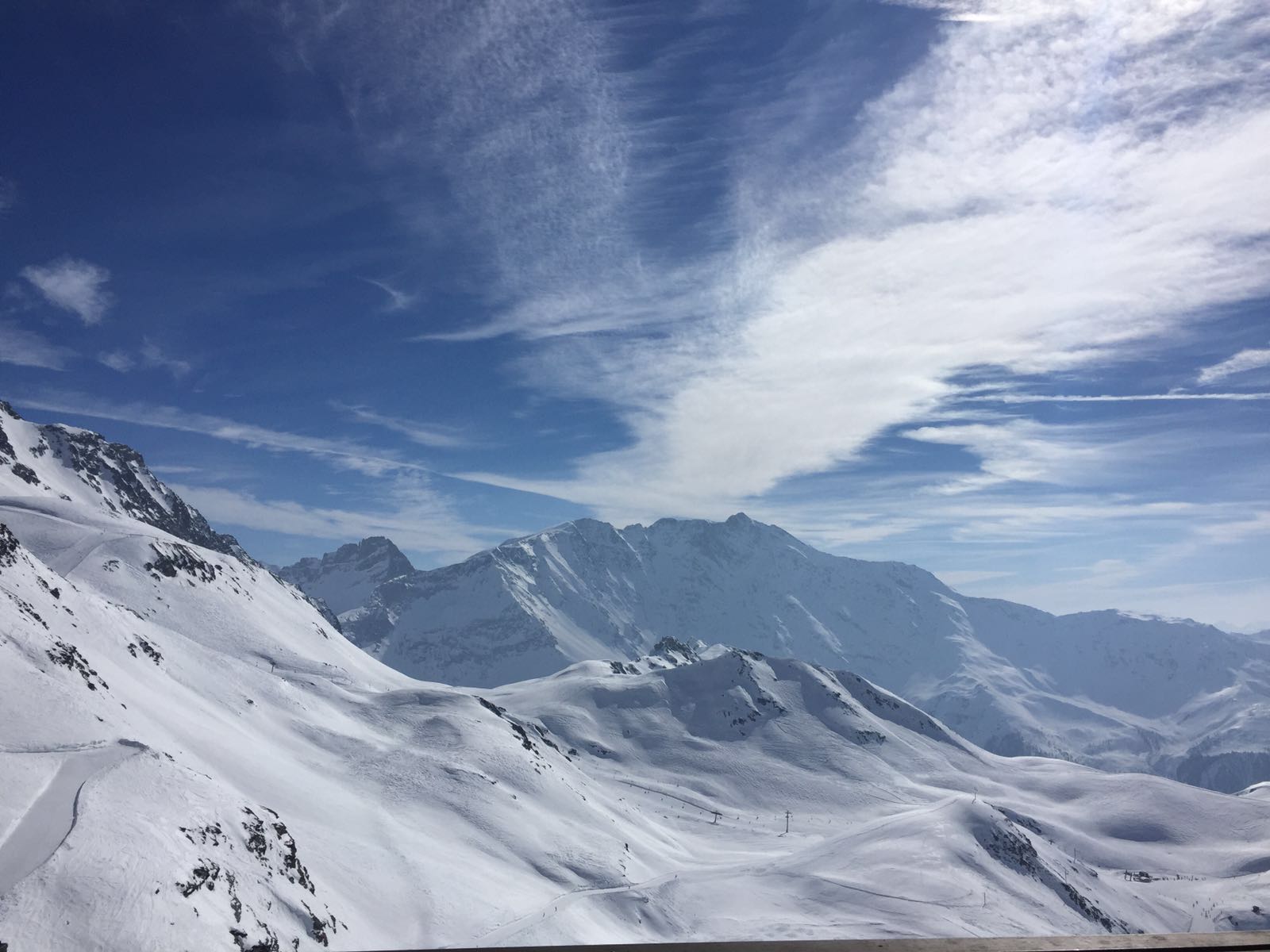
First we must back up in time as it takes a forty-five minute sequence of lifts, a poma, a chair and a gondola, before arriving even near to any of the summits.
From there, the hearty strap their skis to their backpacks and climb. Depending on the particular objective, the uphill walk may take from 15 to 45 minutes. Thanks to the 3,000 metre elevation, I struggle with the climb. Difficult enough in ski boots on the crusty, uneven snow on the edge of a mountain top where one slip can ruin your day, the rarified air intensifies the effort. Climb a little too fast and it begins to feel like you are breathing through a straw! But we do this because so very few skiers do and the otherwise inaccessible couloirs that I will soon ski down take my breath away. But I'm jumping ahead of myself.
I arrive at the summit -- only here can one gaze around in any direction of the 360 degree palette of options, and see forever! The immense blankets of snow spill away below me, the wind having sculpted them into arrays of textures further enhanced by the myriad of shadows realized by the sun's rays, that slowly fade downhill into the distance. Very far below, there is no longer any snow remaining and one can see across to a hamlet, a handful of centuries old homes, patiently awaiting the warmth that always comes with spring. I look up at the horizon, 20 or 30 km even 40 km away to see ranges of snow-covered mountains, some presumably perched above their own ski villages. The air is crisp and so transparent that it feels as though I can reach out and touch the other side. Not a cloud in sight, the sky is perfectly blue although broken now and then by the wispy contrails of jets passing so very high above in all directions whisking their passengers to and fro. I imagine that some of them are straining to see straight down to the very summit on which I stand. It is magical on this sun-drenched day for how can my eyes tire from this that is nature's splendour?
We approach the couloir with trepidation, its pitch is so steep that I cannot see the slope itself even whIle standing at its precipice with my ski tips over the edge. Almost scarier than the steepness is the narrowness, I must manage each turn immediately after the previous one -- there is no space to serpentine downhill as when skiing the vallons. One more concern: falling is not an option. I would slide down at least 250 metres and possibly crash into one of the rock walls on either side of the couloir. It is not terrifying, frankly, as I know I am capable of navigating the challenge, but I am apprehensive, which emotion I conclude will keep me safe. All my senses heighten as I enter and make my first turn. I not only feel the snow's reaction under the weight of my skis but I can hear the comforting sound it makes, I can see the powder kicking up behind me in my peripheral vision, I can almost taste it as I breathe in and out. I have no time to revel, I turn again and again as I advance down the (did I mention?) narrow, steep, scary couloir, stopping every 15 turns to catch my breath and look up at what I have just successfully accomplished. My confidence is boosted, and coupled with the gradually widening couloir, I continue with more finesse than before, and with more satisfaction, too! I cannot be sure that I am skiing better than ever (which I doubt) but I am certain that I am replete with contentment, with the joy of taking the chance to succeed as opposed to abstain, to marvel at the beauty with each pause as opposed to passing up the opportunity and descending an easier slope. Unlike other sports that require motors (like water-skiing) or opponents (like tennis), or even cycling (which requires a path to follow), skiing hors-piste avails the athlete to choose his own route, and speed, and style so long as the laws of gravity prevail. The fluidity or sense of flow that can be experienced is lacking in most other sports but ever-present for me here, now.
Just yesterday, a man was skiing a couloir (alone) at the neighbouring ski resort and fell. All we know is that he was found dead, below, an hour or two later. I suppose with all the millions of skiers that love the sport, and the many thousands that crave the hors-piste challenges, these horrific accidents are bound to happen. Of course I am safe and never alone when I ski. In fact we wear a location beeper if ever the unlikely avalanche occurs and our backpacks contain collapsible shovels, in case.
There are few areas in the world where one can ski down steep, untracked hors-piste slopes from a 3,200 metre elevation down to 1,200 metres, the last 300 metres through the woods, without seeing another human other than those in your own group. And for me, the frequent pauses to recover my breath give me pause to gaze around and remember that the possibilities are infinite!
Here's hoping you can pause, breathe and be grateful, from time to time, too.
Barry
Tuesday, July 7, 2015
Postcard from Croatia's Dalmatian Islands (postmarked 02 July 2015)
Eastern Europe. It's not the like anywhere else on Earth. And Croatia, having been ruled by the Italians, the Slavs and others, in turn, over the centuries is a special place within Eastern Europe. Somehow, though, the Croats, despite what they have been through in just the past three decades, are a mighty friendly bunch, ready to help at every juncture. And nearly all are fluent in English, albeit with their own unique brand of accent.
We went on six hikes during this holiday, roughly one every other day. Each successive one was increasingly challenging. The highlight was the fifth, the six-hour climb up Croatia's second highest peak, Sveti Jure, at nearly 1,800 metres above sea level. Many peaks here begin with the word 'sveti' so I had naturally assumed that it was the Croatian word for 'peak' or 'mount.' Only after a week did I notice that nearly all churches were also named Sveti something. Turns out that both churches and mountains are normally named after a saint and Saint Yuri won the title for our hike selection. There are several routes to the top of Sveti Jure and we chose what turned out to be the most difficult. Starting at sea level, in the town of Makarska where we had spent the evening and night before, we walked uphill through the town's suburbs to its outskirts and the trailhead. From the trailhead and for the next two hours we climbed the steepest slope of my hiking experience. Much of the slope was covered with rockslides and being too steep to hike up safely, it was criss-crossed with switchbacks, themselves so steep that we needed a break from the burning sun baking us from above and grilling us from below, and from our sweaty effort, every 45 minutes. A lone tree casting its shade across the route was all it took for us to call for a pause to eat and drink and rest. At other sections later on we had to leap from boulder to boulder to make progress. These sections are always fun and remind me of a childhood adventure that I might have enjoyed, but for which I am today grateful. For a welcome break, we also had to traverse flowering alpine meadows, lush with tall grasses bent over in the blowing breeze and peppered with pockets of whites, yellows and purples. And suddenly, it seemed, we were passing through a dense forested valley replete with birds flitting through the canopy above and a soft leafy bed beneath our feet. No difficult climb would be complete without some scrambling. Both arms and upper body strength were requisite in these sections of the route where it is necessary to hoist ourselves and backpacks, too, several feet straight up using rocks, crevices or tree roots as handholds The burning sun was relentless but fortunately the increasing elevation resulted in the air becoming cooler as we ascended... from 30C at the sea to 14C at the peak, the cool, thin air at the summit was indeed both refreshing and welcome. Even more refreshing is that because this mountain has a large television tower at the summit which requires regular maintenance, there is a service road from its base to the top, and, so we have an air conditioned taxi van waiting for us at the summit to whisk us back to town far below, all arranged two months beforehand!
The port town of Hvar on the island of Hvar has earned itself a reputation of being party-central for all of Croatia. Appropriately, hotels, restaurants, cafes and all services cost nearly double compared to the rest of Croatia. In return we see the young, jet-set eastern Europeans at play. Thanks to a fortuitous twist of fate we are spending two nights at a $400-a-night hotel and get to partake, too, while in luxurious surroundings, enjoying scrumptious buffet breakfasts, cascading swimming pools with swim-up bars, a private beach and more. The town harbour is surrounded on three sides by numerous cafes and lounges that quiet down only at dawn. From what I can discern, most of the young revelers are drunk by 1am but stay out much, much later, likely requiring a review of selfies and friends' pics the day after to know how much they had enjoyed themselves the night before. Not judging, just saying. The hike that I had charted for this island took us through fields of wild lavender up to the higher reaches of the area. Unexpectedly, en route, we fell upon perhaps the world's only lavender festival, an annual event lasting two days in the tiny village of Velo Grablje. This town boasts a lavender mill where the plants are processed to produce their oils and essences. The next day we rented scooters and visited the other large town on the north side of Hvar, Stari Grad. Always to be remembered as the location where I enjoyed the best ice cream in Croatia, it will also be an overnight stop on my next visit to this country; besides the rich, cold, tasty ice cream, it is nearly void of foreign tourists, yet one can still rent a bicycle or charter a sailboat as well as choose from one of a couple of dozen quaint restaurants for al fresco dining along the picturesque harbour. One quickly becomes accustomed to, and thus forgets to explain, that every home, restaurant and shop in these ancient harbour villages was built centuries ago, by hand, from stone and mortar, with electricity and plumbing incorporated years later. The windows cut into the walls are ornate with carved perimeters, the cement railings along stairways and terraces are adorned with small statues, all the roofs are covered with the ubiquitous, Mediterannean, curved, red clay tiles. The streets in all the old towns are made from the same stone, worn smooth by centuries of pedestrian traffic. There are never cars in the old towns as even the widest streets are too narrow, but even so, motorbikes and scooters are forbidden. There are few street names and barely an assigned address in the old towns. Directions to a guest apartment or shop are given today exactly as they must have been two millennia ago, with a series of hand gestures and a reference to a clock tower or church.
We went sailing on our first day in Croatia, around the Elafiti islands which spread north from Dubrovnik in the Adriatic Sea. Of Croatia's 1,240 Dalmatian Coast islands, 14 of them are Elafiti. One advantage of traveling in a group of ten is that we get to charter our own sailboat and so chart our own course! We set sail for a nearby, uninhabited island, one which has an underground cave, that is to say, the cave is accessible by swimming under a natural arch made from the rock cliff above and entering thus. What I found uniquely exhilarating is that the daylight enters the inside of the cave by the underwater entrance as there is no other source of light. As a result our bodies are illuminated by an eerie blue light, but only from below. We all look like aliens to each other with a blue glow reflecting off our bodies, but only on the parts of our bodies that are underwater. The top of our cave is about ten metres above us and the floor is about the same depth below. The seawater is warm and buoyant making it delightful to swim and difficult to leave the sea and climb back into our sailboat. Did I forget to mention that here and everywhere else that we traveled, the water is unusually crystal clear? We can easily see down ten to fifteen metres and discern details on the sea floor! A little later, after sailing further north, we have docked at the smallest island fishing village, Sudurad on the island of Silovo Selo. It has only one cafe, where we all ate at a long table set up outdoors on their terrasse, shaded by a living roof made of a variety of flowering vines. This was to be the first of many, many meals shared by friends, at a long table with ample glasses of beer and wine, fish soups and salads, grilled seafood delicacies, banter and laughter, much like we often see in the movies wishing we could partake in the experience, too. Perhaps of all my memories of traveling through Croatia (and Montenegro, too), the ones of lunches and dinners will be the most savoured. We were without exception the only group to be living life 110%, from our midnight drinks on the top of a castles's turret in Korcula to our post cycling lunch at the Konavle winery south of Dubrovnik. How do I know? Because sadly, the majority of other diners spend a great deal of their mealtimes ignoring each other and their surroundings while silently texting somebody else somewhere else.
On that note, here's wishing you are living life, too, in whatever place you may find yourself today!!
Barry, now part Croatian, part Canadian
Tuesday, March 31, 2015
Postcard from Alpe d'Huez - 1,800 m elevation (postmarked 29 March 2015)
Hi!
There is no debating the unparalleled, spectacular views from Pic Blanc (3,330 m). The colour of the sky is not just blue, but blue within blue; the snow capped mountains surround us 360 degrees around at varying distances, 10, 20 and even 30 km away, their peaks piercing the heavens and often caressed by wispy clouds. And the snow is not white but brilliant, bleached white, almost blinding. Notwithstanding the fierce struggles and tumult all around the world, it is eerily silent here, probably the same silence that a deaf person must experience. As though all this were insufficient, unlike anywhere else in the French Alps and for reasons unknown to man, there is most often a temperature inversion here, with the valley below our alpine village colder than above in the mountains, resulting in a blanket of clouds forming below our village, filling the valley completely. It seems as though our 240 kms of skiable slopes are on an island, suspended above a bed of clouds. Hence the name known locally, l'île de Soleil.
Now that I have diligently described to you our island of paradise, let's talk about skiing! What uniquely distinguishes this 'station de ski' is the 'hors piste' or off trail skiing. It is our guide's mission in life to steer us away from the groomed trails and into the most challenging descents accessible. We invariably start each effort by skiing under an out-of-bounds rope clearly identified with signs in several languages and various pictograms warning of the risks of falling off cliffs, skiing over rocks and getting buried in avalanches. Fair enough, but each of us is carrying a beeper in case we get caught and buried in an avalanche; and each of us wears a backpack containing a fold-up shovel and other instruments in case somebody else gets buried. Feeling safe, one by one we follow the leader, traversing along the very steep edge of a mountain, the left side rising seemingly vertically to its summit, the right side falling precipitously down to a nasty ending. Below my skis follow two narrow tracks as I concentrate on leaning very slightly left as I glide forward. Finally we arrive at a plateau. There are many at Alpe d'Huez and as we are far above the tree line, they are all barren, covered in virgin snow, interrupted by rocky outcrops which we navigate between.
This lunar landscape is most exceptional and disorienting, too, as the guide weaves his way forward and down, sometimes leading into a giant bowl 200 m long and equally wide where we can each find our own fall line to ski down fresh snow, leaving behind fresh tracks. Where he is ultimately leading us is to one of many couloirs, which are steep, narrow, snow-filled gullies, 300 or 400 m long, sometimes only as wide as the length of my skis, or so. Negotiating these narrow couloirs is as challenging as the sport can offer and I am frankly overwhelmed with pride if I manage the challenge well -- that is to say not every descent is as fluid and successful as I plan.
This station claims to have the longest black diamond run in Europe. My friends and I are good skiers but it still takes 15 minutes to get to the bottom which we normally save for the last run of the day -- the only run we make that is 'sur piste' or on the marked trails. The difficulty of skiing hors piste has its rewards: the shear pleasure of descending the mountain by way of the natural landscape, not always sure of where the next slope or turn leads. Incredulously, navigating the same vertical drop of 2,000 m as sur piste takes us over an hour. Once at the very bottom I am normally exhausted, beat up, overheated and blissfully ready to get back to Pic Blanc and do it all over again!
May all your runs take you downhill!
Pic Barry
Sunday, January 18, 2015
Postcard from Punta Banco (postmarked 13 January 2015)
No, you won't find it on the map.
Serendipity and the invisible hand of fate conspired to steer me to the end of the road, to the furthest point south in Costa Rica, to a tiny community of a hundred persons: Punta Banco. Replete with a tiny, turquoise church, an even smaller school, a soccer pitch, four supermercados (each one smaller than the other) and a stretch of beach to which only a picture postcard could do justice. Palm trees caress the entire length of beach, their huge fronds swaying in the Pacific breeze, many of them hanging over at impossible angles, laden with coconuts waiting for a stronger wind or a machete's swipe, so that their nectar can be savoured. And behind the palms is the jungle, splendorous in colour thanks to the rainy season having just ended. The multi-hued birds of paradise and other flowers and orchids stand out brilliantly against their lush, green background of ferns and palms, mangoes and star fruit trees.
This is home for my friend, Gabriel, for several months each winter, and now it is mine, if only for two weeks.
Yesterday, we rose at 5am to the screeching of howler monkeys. Our bare necessities cabinas are surrounded by verdant jungle on three sides and these aptly named monkeys get a head start on the roosters to greet the new day with their howling. The local botanist claims that their noisy cacophony is how they mark their territory each dawn (and dusk) but my own theory differs: why would supposedly intelligent primates have to so frequently remind all the neighbouring intelligent primates of this same fact twice a day, every day? Surely they are simply welcoming the new day with a primate singalong . My alarm was set for 5:30am but that was a moot point a half hour earlier. It was no longer possible to sleep. We ate a home-cooked breakfast of eggs and rice and beans and headed out along the beach before 6am. There is something odd about a long hike which starts out on a beach. It seems as though I am casually walking along the beach as we have all done countless times. The waves are crashing repeatedly to the right. We can see the fisher birds squawking as they hover, searching for their breakfast just above those same waves which churn the fish about and bring them closer to the surface and to the birds' hungry beaks. When the locals see the birds feasting like this they scramble for their own fishing gear and join in. Farther overhead we see an impressive flock of pelicans flying in formation, although presently in a single undulating line, not in the expected V-formation. Even though we are 200 feet below them, we can see that they are very large and graceful, too, slowly flapping their huge wings to stay aloft. We are walking south so the sun is not yet shining on us, it has just risen and is blocked by the tall cliffs or mountainsides that often end on the beach, each one covered in palms, ferns and other tropical growth.
After an hour we cross a river emptying into the sea and then turn left and climb up away from the beach and into the jungle. It is still very early in the morning, the sun has yet to rise much above the horizon but the heat of the day and humidity have now begun to become oppressive, especially since we are climbing steeply and perspiring. The trails we follow are known only to the indigenous who use them routinely to transport provisions up to their farms by horseback and to carry down the fruits of their labour to market. Our guide, Moe, is well known to the community as is every farmer and farmer's son for miles around. After several hours of uphill progress through the mountains, the farms and the jungle we have arrived at a small, unremarkable stone monument which denotes the border with Panama. We step into Panama and sit ourselves down on a log for a well-deserved Panamanian lunch!
The trickle of cold water that claims to be my shower is no match for the creek behind the house. During the rainy season it earns its name of Rio Nicaragua but now the waterfall that feeds it is hardly the torrent it was just one month ago. Bathing in the pool of fresh, cool, water at its base has become one of life's quotidian pleasures, cooling me down now so I can sleep comfortably later as I wash off the perspiration and salt of the day's activites. I can see parrots flying overhead in pairs, some with tails eighteen inches long -- macaws, apparently -- wings that seemingly change colour with each flap, first blue then green and then red, as their melodic songs drift down to me below. A four-foot long sloth lazily inches past on the riverbank, in no hurry at all to arrive at its destination, likely the branches and leaves of the mango tree that they adore to munch on. During yesterday's bath it was an anteater that ambled by, tomorrow I am hoping to see a jaguar as I bathe; it is the largest creature to inhabit these jungles.
And so life goes on at the end of the road, hiking, biking, horseback riding, deep sea fishing, panning for gold, a class at the nearby yoga farm, the market in the nearest village, surfing and swimming at sunset -- the ocean is so warm and the waves are big!
The locals use a salutation here in the way the hippies of the '60s used to say 'Peace' or Spock's 'Live long and prosper' or even Yoda's 'May the force be with you.'
It is 'Pura Vida!' -- you could translate it as you want ("pure life?") depending if you lean more towards the hippies or the Yoda lifestyle. I think it's high time we had a more interesting salutation at home to replace the tired 'See you' or 'ciao' or 'salut' -- your thoughts...?
Barry
Sunday, July 13, 2014
Postcarta continua (postmarked 29 June 2014)
Buon Giorno again!
In the event you are unaware, I am leading four other intrepid backpackers on a hike from Amalfi to Sorrento over a seven-day period. On four of the mornings we hike up into the mountains with all our belongings (about 15 kg each) neatly stuffed into our backpacks, climbing rather steep mountains to an elevation of approximately 600 metres, then hiking parallel to the sea for about 10 km on paths that have evidently been employed for hundreds of years as supply routes until the arrival of the automobile 60 years ago. We then descend to the next seaside village and check in to the next hotel. On the other three mornings, when we spend two back-to-back nights in the same village, we have the opportunity to chart a hike higher up and further away, carrying only a lighter day pack, eventually looping back to our starting point.
From beginning to end we will have trekked over 100 km, with a total elevation gain of about 7,000 metres. If you see me soon after my return and I am limping, there will be no need to ask why!
As I was recounting recently, we had arrived at 1,040 metres elevation to find a large, abandoned monastery. A dense, cool fog had mysteriously rolled in (again) making it difficult to see and it began to feel like dusk even though it was barely 3:30pm. Locating the other trail which would take us down to Ravello was thus proving challenging when out from behind a small outdoor alter set high on a rock outcrop, there most suddenly and surprisingly appeared a skinny, Italian pilgrim with long dreadlocks, wearing a tattered friar's outfit. Until this moment, we hadn't seen another human since refilling our water bottles at the town fountain in Perogela. He reminded me of all the modern day portraits of Jesus Christ so his unscripted entrance in the monastery's vicinity seemed somehow fitting. He confirmed our choice of trails in broken English by reminding us to simply "go down, down" and then he quickly disappeared into the mist as if he were never there. Very strange.
Did I mention that the views from high up are breathtaking? Foggy periods excepted, every time a path takes a new twist or turn, a different vista is laid out before us: mountain sides fall away revealing small villages perched below on their faces, beyond which lie other villages further down one slope or another. Below those will appear a seaside village with improbable names like Minori and Maiori, with the shimmering Mediterranean sea lapping at its beaches or smashing into its cliffs. It is quite impossible to tire from the various views of the lemon groves and goat farms, the villages to which they belong, the sea always generous with its deep blue temptations, beckoning to us in the distance.
The hike downhill requires less effort normally, however we noticed that the clouds had become more ominous, the air was getting heavy again and we quickened our pace. We arrived in Ravello in no time and stopped in, famished, at the first restaurant that we stumbled upon. In just a few seconds it started raining and then only moments later the skies were booming with thunder as the rain intensified into a downpour fit for a jungle. It was our first of seven all-day hikes and the second of many lucky turns of events (remember the friar way above). The gods were looking out for us indeed!
Here's hoping that the gods are on your side, too!
Barry of Amalfi
PS. Before I let you get back to your everyday musings, I will share one additional good luck story. Upon arriving in Sorrento, we learned that the owner of the hotel, Biaggio, was a "world-reknown" chef and was in fact giving cooking classes daily at 4pm. People come from all over Italy and indeed from the world over to take a week or two of Italian cooking lessons. This is how I find myself, hands-on, preparing spinach gnocchi in pesto sauce from scratch, fried anchovies, eggplant parmesan and a chocolate dessert, too. The kicker is that the entire four-course meal is served to all the hotel guests who choose to stay for dinner. A long table is dressed on the hotel's front terrasse under the warm deep blue skies at dusk and 14 guests, Swedes, Germans, Americans and Canadians, are treated to the meal that I and two others have just prepared, under the watchful eye of Biaggio. Italia rocks!
Subscribe to:
Posts (Atom)