Showing posts with label Greece. Show all posts

Tuesday, November 5, 2024

Postcard from the Aegean Sea - postmarked 02 October 2024

With most ambitious objectives, we rarely come out the other side the same person as we were going in. Indeed, with a little self-reflection we will likely realize how we have grown immeasurably. With this belief in mind, I accepted my brother, Stan's, invitation to join him and our cousin, Steve, on their annual week of sailing. This year, it was to be in the Dodecanese area of the Aegean Sea, beginning and ending on the Greek island of Kos, only a few kms across the bay from the Turkish port city of Bodrum.
As many of my regular readers know, I have sailed several times with friends, on my buddy, Kosta's 37-foot catamaran, always in and around the Argolic Gulf, the body of water that opens up south of the Greek Peloponnese town of Nafplio. I must come clean: after these few sailing adventures with Kosta, I failed to acquire more than 25% of the skills required to sail a boat. Perhaps now it is clear to you why I say that this sailing objective is ambitious, first being an inexperienced sailor and second spending a week in close quarters with two family members for the first time in decades. Between my brother and our cousin, together they have about 95% of the necessary skills. These are: navigational; technical; radio communications; choosing an awesome protected cove for lunch and swimming; good habits to minimize all risks of personal injury and of falling overboard; maintaining sufficient fresh water and gas; and the discharge of waste when permitted. Did you know that boats do flush their toilet's holding tanks straight into the sea, untreated, once they are at least 3 nautical miles away from land? It's best to choosing swimming spots close to the shore!
Now that I have sufficiently communicated these niggly details to you, let's get back to my adventure. The main town on the island of Kos, is predictably named, Kos. Nearly all references to Kos, when written in Greek capital letters, drop the last letter, leaving kappa omicron (ΚΩ vs ΚΩΣ). No Greek individual could explain this anomaly to me so I turned to AI: "Some Greek signs and casual writings abbreviate place names, especially short ones, for simplicity or stylistic reasons. This is especially common with tourist locations, where it’s understood that "Κο" still refers to "Kos." This is a feature of the Greek language’s flexibility with nouns, particularly proper nouns like place names."
The town is very touristy, dominated by its wide harbour and many, many large (tourist) pirate ships that each promises to take its passengers for a day sail to three nearby islands and the opportunity to swim at each stop, serve a lunch, and all the suntanning a 20-something could hope for. The street parallel to the harbour is lined with many restaurants, a few bars and more than a few tourist shops, all of which spill over onto the wide sidewalk. Several narrow streets and laneways in back contain many more shops, kebab stands, markets, and ruins, too. Similar to the rest of Greece, Kos has remnants of civilisations long gone: stone archways still standing, leftover columns with missing capitals, and pieces of ancient buildings strewn about. Hippocrates supposedly lectured his students here, they say under a large tree, still standing 2,400 years later, labeled the Hippocrates tree, one of Kos's must-see highlights. The main harbour, just referred to, is for commercial boats only. Our marina is a 15-minute walk away, very modern, with space for 400 sailboats, enclosed by a seawall which keeps out waves, currents and swells. Most of the boats here are from 35 to 55 feet in length, both monohulls and catamarans (which have two hulls). Our boat, The Hobbit, or Χομπιτ, is 35 feet long with three cabins and one head, or bathroom. Of course, we have a kitchen, dining area below deck, and living area on deck.
Ideally, we would have had light winds early in the week, which would get stronger as the week advanced along with our sailing skills. The gods had different plans for us! Our first day of sailing had winds of 25 knots gusting to 35 with swells of two to three metres. I believe that the Universe gives us not we want, but what we need. And evidently, we needed to sharpen our sailing skills with no time to lose as these strong winds can blow a boat over, or onto the rocks had we steered off course. The winds were blowing from the northwest today and guess what? Our first day's destination was to the northwest as well, to the island of Leros. Sailing into the wind is uncomplicated under normal conditions however when the winds are strong the forces acting on the boat can be challenging to manage, doubly so when the whitecaps are crashing against the bow as we pitch forward on the backside of each swell. If you are prone to seasickness, my advice to you will be predictable. An interesting phenomenon to note: even though our speed across the water is barely 9 knots (16 km/hr), it feels like 30 or 40. It is an illusion that nobody can explain. In any case, it is exciting to manage the sailboat's course, tacking occasionally, as we steer slightly left of straight upwind, then slightly right, to keep to our northwest bearing overall. One of our daily pleasures, which I alluded to earlier, is searching for and choosing a small cove or inlet for our lunch stop. If we can find one that is protected from the winds we will be sure that our anchor will hold so that we can enjoy our meal in calm waters. Did you know that the weight of the 40 metre chain, when letting out the anchor, is as much a reason as the anchor itself for keeping the boat from drifting?
It is always a thrill for me to dive into very deep water. There is no chance of touching ground (even if you tried to), so the swim has another degree of freedom. An entire world may exist below, perhaps schools of fish passing by in search of lunch, but at the surface it is just me and 360 degrees of choices of which direction to swim. The water is so very blue, I think its colour is enhanced by reflection off of the sandy bottom. Thankfully it is warm enough that I avoid getting the chills as so often happens at home in my lake after only fifteen minutes in the water. When I was an avid runner, I used to joke that all runners end up in the pool. Once your body starts complaining about the pounding it takes from too-frequent running, we turn to cycling as it is easier on the joints. Until the shoulders start hurting from continually leaning forward on the handle bars. In the pool, or in the sea, there is no tension at all. The water supports every swimmer's weight just perfectly. Even more so in the sea as salt water is more buoyant than sweet water, which makes it even easier to stay afloat and swim greater distances. A bonus: Salt water is nature's purifier of skin and nails, killing, over time, most superficial skin infections, pimples, toenail fungus, etc. I always swim wearing a long sleeve swim shirt, however, to protect my back and arms from the sun's rays. After a few minutes of using the same stroke, I confess that I start to daydream. It's a wonderful feeling, I highly recommend the experience, until thoughts turn to what may be lurking below! I sometimes wonder whether it is me that is on some deep-sea predator's fish of the day lunch order!
I imagine it must be quite a unique lifestyle to actually live full-time on a sailboat. All your worldly possessions have to fit in the boat as you have sold your home or given up your apartment. No fixed address. Pick a coastline anywhere in the world and spend the next year or two sailing from port to port, deciding on a whim to stay put at this town or another for a few days or a week, and then sail on. I suppose you could do this in an RV camper, too. But, it simply seems so much more practical to have the sea as your highway, with no traffic lights, speed limits, traffic jams, or roads under construction to contend with. I understand some people make a compromise effort and go on an around-the-world cruise for a year, if they can afford this. I have a friend who contracts himself out as a first mate and sails for weeks at a time, helping the captain on a daily basis. He is neither paid, nor does he have any expenses while aboard, and, he gets to see the world one port at a time. How would you choose to see the world?

Monday, October 10, 2022

Postcard from the Argolic Gulf - Postdated 30 Sep 2022


At first blush it would seem preposterous that I would return to Greece to go sailing with Kosta. As I recall from my first (and only) sailing expedition with him, five years ago, the cabins were tight and the bathrooms were tighter still (use your imagination). On the other hand, what a fantastic opportunity to visit so many ports without having to unpack and repack my luggage at each stop as one has to do on a road trip. My last adventure with Kosta was for five days, so I doubled down and suggested that we sail this year for ten. I invited some others to join in and before I knew it (months later), we were all aboard, meeting the sailboat in Poros, a most lively town on a large island about an hour away by "fast ferry" from Piraeus, the famous port that serves Athens.
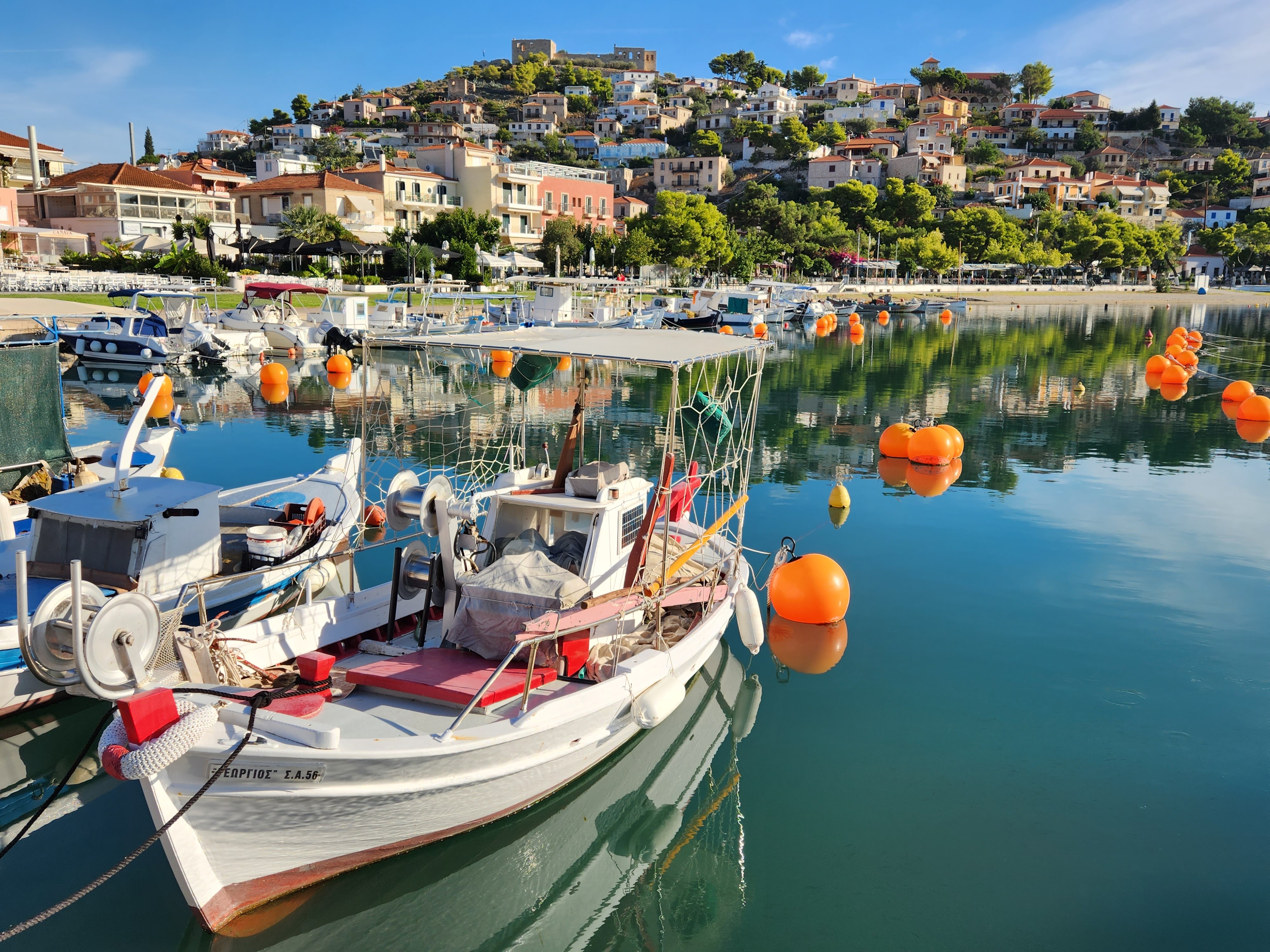


Kosta's sailboat, the Kime, which means Wave, in Greek, is a 38-foot catamaran with four cabins below deck. Each cabin has a double bed, some shelves and a tiny porthole which is more for air ventilation than for peering out. In fact, I have to admit now, that it is spacious enough if you are solo, and as long as you only use the cabin for sleeping and nothing else. Back upstairs, there are two large areas for sitting or eating on deck, one inside which is practical if it is raining or cold (not often the case in Greece), and one outside which fortunately is covered by a bimini to keep ourselves from broiling under the very hot Greek sun.


One of the advantages of sailing with Kosta is that he is as active as I am. At nearly every port that we docked, we either rented bikes or hiked up a nearby mountain, usually in the afternoons. One memorable hike was near Astros, a charming town, four kilometers walk from the marina. The entire uphill portion of the 14-km hike was on a dry creek bed. It was rather steep, about 900 metres up over 6 km (this calculates out to 150 metres elevation gain -- a 45-storey building's worth --  for each km walked). The creek bed, at the bottpm of a canyon with nearly vertical walls up to the ridges high above, was strewn with huge boulders, mostly bunched up in cascades to form huge obstacles, each about 10 - 20 feet high, between short strectches of flat hiking. These cliff-like rocky structures transformed this climb into one of my best hiking experiences. It was loads of fun scrambling up the rock faces, often at a faster pace than simply walking. It reminded me that I need to return to rock climbing again after the long lull caused by that spooky pandemic.


It was a typical Greek scorching hot day, although mercifully a couple of degrees less extreme in the mountains than in town below. The weather called for short pants. The only downside were the hundreds of prickly and thorny small bushes that reached out from the edges of the trail or from between the rocks that we were scaling which frequently scratched my legs. You know that you want to avoid these nuisances as many of the scratches drew blood!


Once we eventually reached the summit, a two-km walk on top of this mountain range followed, between grazing herds of bleating goats and sheep. Before long it was time to follow the trail back down to Astros. Nobody warned us that we were about to walk down the face of a 2,500-foot cliff. If Kosta hadn't promised us that he had done this once before, I would have bet a year's pay that only mountain goats and suicidal burros would venture down the narrow path etched into the cliff face. If you look at the photo below you will be hard-pressed to even imagine, let alone actually see, a path down from the summit, switching back from left to right and right to left along its descent. It was exhilirating. It was exciting. And it is unforgettable. Now I long to find more such hikes and simply skip the casual ones, starting today.


After a few days of sailing in the Mediterranean Sea and the Argolic Gulf, I more fully appreciated the freedom that sailors enjoy: unlike on the restrictive, crowded one-dimensional terrestrial highways, at sea we are free to sail in two dimensions, in any direction on its surface, and at any speed with hardly any concern for traffic. When it gets very hot, we simply find a bay, drop the anchor and dive off the boat for a swim. We did this every day, taking advantage of the warm, clear blue waters and regularly swam about 500 metres to a beach where we chatted, skipped stones along the water's surface and then swam back to our sailboat. A kilometer swim each day in the healing salt water is likely more healthy than jogging or weight training. With perhaps only an exception or two in decades, I hadn't skipped stones since I was very young and the joy of (again) perfecting the art quickly brought back to mind my fondest childhood memories of summers on Nantasket Beach, on the South Shore of Boston, where I "grew up" on the Atlantic Ocean. 


In case you haven't inferred, each of these beaches is deserted as they are inaccessible by car. At times the bays where we weighed anchor had other sailboats parked as well, however we were usually the only swimmers. It is cool to be able to see clearly 20 meters down to the seabed but I suppose it may be scary for most people to swim in such deep water. I was wondering if maybe it's not the depth, however, but the fear of scary marine monsters that may be lurking below, waiting for their chance to snack on an unsuspecting human above.


Did you notice that I referred to the Mediterranean as healing. I am uncertain how well documented the healing powers of salt water are in the medical literature, however, I am convinced that a daily swim in salt water will cure all dermatological problems. Pimples gone, dry skin no longer, toenail fungus healed, itches and scratches disappeared. If you forgot that I revealed to you how my legs got scratched up the day before while hiking, my legs did remember for me: each scratch was burning in the salt water, feeling as though razor blades were maliciously cutting up my legs. I imagine that this is the first symptom of speedy healing and so, in my own mind, I transform the discomfort of a thousand cuts into little pleasures. These are some of the reasons why I always imagined that I would return to my childhood summers by living again on the sea, once retired, somewhere in the world. At least for part of the year. This is a work in process, of course, and this season's progress is marked by ten days of sailing in Greece.


Naturally, one of the benefits of living on the seashore again will be a visit from you!

Barry, retired but not yet retarded 😂