Tuesday, November 15, 2022

Postcard from Portimao - Postmarked 15 October 2022

 I didn't know what I was getting myself into. How could I have known beforehand? Now that it's over and done with, I can reveal to you all about one of the most rewarding experiences of my life.

Have you ever heard of the sport, Ultimate Frisbee? I admit that I had heard of it once a few years ago but I had absolutely no idea about the game, the rules, nor about the worldwide community of passionate players.


Imagine a team sport that is very competitive yet has no referees. No umpires. All fouls or infractions are called by the players themselves and then quickly resolved themselves. The two (or three) players party to the infraction, talk it over quickly, using hand signals (there are about 40 of them) so the other players on the team also understand what is taking place, and then they agree on how to proceed. Another interesting reason for the hand signals is because players from opposing teams may be from different countries and not share a common language!

This team sport is called Ultimate Frisbee, or simply, Ultimate, for short. As you may recall, I had expected to be cycling with Marc for two to three weeks in the south of Spain immediately following my sailing adventure in the Argolic Gulf in Greece.

Marc, however, two weeks prior informed me that he would be flying to Sardinia for a month after only five days of cycling with me in Spain. Something about a woman. 


Of course you've heard the expression, when one door closes another opens? No sooner was I out a cycling buddy, I received an offer to be a scorekeeper at both the European Ultimate Beach Club Championship and the World Great Grand Master Ultimate Beach Championship, both taking place, consecutively, in Portimao, in the Algarve, Portugal.

Of course, I accepted the invitation that came in through that open door. While at home, everything in Europe appears to be so close together geographically, but when in Europe even traveling from one country to its neighbour may take some time. Thus, after a five-day unplanned visit to Sevilla and two more days in Lagos, I arrived on schedule in Portimao to learn about my scorekeeping responsibilities. Those two city visits en route may land in their own postcard one day soon.


With 900 players representing approximately 60 clubs from 25 different countries playing on 12 sandy courts for three days straight, you may imagine all the logistics that are needed to manage even a half-day of games and their results. Plus of course the fifty volunteers and staff, including scorekeepers, medics, I.T.,  meal preparation, the media, etc.

By now you must be wondering how complicated can it be to keep score? Each scorekeeper starts the game by blowing the whistle and yelling "Play" or something similar and then starts the stopwatch. So far, easy-peasy. I like to give the two teams a five-minute advance warning, too, as they are all on the field warming up by then, and they love to have enough time for a team huddle before the game officially starts, to boost their energy and team spirit. We also have to keep track of who scored and who assisted each goal plus the time of the goal, and then change the score on the scoreboard. We have to keep track of the time elapsed throughout the game.


The teams flip a couple of frisbees before the start of the game to choose who starts on the offense and we note this, too. At the half time, at 25 minutes, or when one team reaches seven points, the teams switch sides as there may be wind or sun which favours one direction or the other. There are many other timing rules to know however I will spare you any further details. Enough to understand we are blowing the whistle regularly to keep the game moving along.

However trivial all of the above may sound, it is this that I found both mind-blowing and heart-warming: one team's players sometimes congratulate the other team's players during the game after a well-played goal. When a player calls a foul on another player, say for interfering with a shot or a catch, the player calling the foul explains what he or she feels was the foul and the other player will agree or else explain why what happened was not a foul. There is never a fight or raised voices, even in an important game where every goal scored can ultimately determine the winning team. After about 30 seconds of negotiating they agree on a resolution and the play continues. We scorekeepers do not mix in. In my seven days of scorekeeping, on only one occasion the two players were remarkably making no progress after a full two minutes of "arguing" so I blew my whistle and yelled, "captains." I remain uncertain if that was a legal call, but every player on both teams was relieved as the two team captains got on the field to weigh in and 10 seconds later a decision was agreed on.

The players from both teams often mingle on the field (ie., the beach) and chat about the last time they met at another competition or about a game earlier in the day. Or they horse around with each other, like kids playing on the beach. They often give each other advice for improving their playing. This takes place both before and after the game is played, or during the game as the players on the sidelines don't always stay close to their own teammates.


Another oddity which I've never witnessed elsewhere: after the game is over, all the players from both teams huddle in a large "spirit circle." They alternate in sequence a player from each team, so that every player has on his or her left and right a player from the other team, their arms are all interlocked behind each other's backs, everybody facing inwards. Each team awards a small meaningful gift to whom they have voted the best player from the other team and to the player from the other team who has shown the best spirit.


In this sport, the object is not to win the game at all costs, but rather to win the game with the best spirit. How many times did players thank me and my partner scorekeeper (it takes two scorekeepers to keep track of all the details during each game) for being volunteers, I lost count? We were always greeted with enthusiasm both on the field and at random encounters in town in the evenings. In fact, some of my fellow volunteer scorekeepers were players themselves on teams that did not qualify for this championship. They wanted to witness the games without having to pay all the travel expenses, as all the room and board expenses were paid for the volunteers. Thus, I met dozens of players from all over Europe, the States, Canada and Japan. I can count some of them now as friends.

It is a passionate worldwide community. The Japanese team had a relatively high expense to participate due to airfares (I suppose) and were short a couple of players. Thanks to a worldwide Ultimate Facebook group, a German and an American joined their team, having already met the team's members at a prior championship. I am under the impression that many of the teams had to borrow a player or two in order to compete with enough players, usually 15 per team, although only 5 at a time are on the field during the game.

To cap off the three or four days of games, at the end of each championship, the biggest disco club in town, The Mixx, was rented at night for a big private party for all the players, volunteers and staff. Similar to what I witnessed during the games, everybody mingled, danced and drank with others regardless of team membership, country of origin, etc. The very competitive spirit on the field is present but always within the context of the sport remaining non-contact, the rivalries friendly and the spirits high. And it is these high spirits that warmed my heart continually, that were contagious thankfully, but not because of what I have shared with you, above. Rather because we so often lack such high spirit in our daily routines and now I am invigorated, I am reminded that I can smile even more and congratulate my friends for a goal well played, and to pay it forward, as it were.


My only sad moment was in saying farewell to all, the morning after, when nearly everybody departed Portimao. In my case, I wasn't going home however, but on to Madrid for another adventure with no set end date.

Retirement is highly underrated!

Frisbee Barry

Monday, October 10, 2022

Postcard from the Argolic Gulf - Postdated 30 Sep 2022


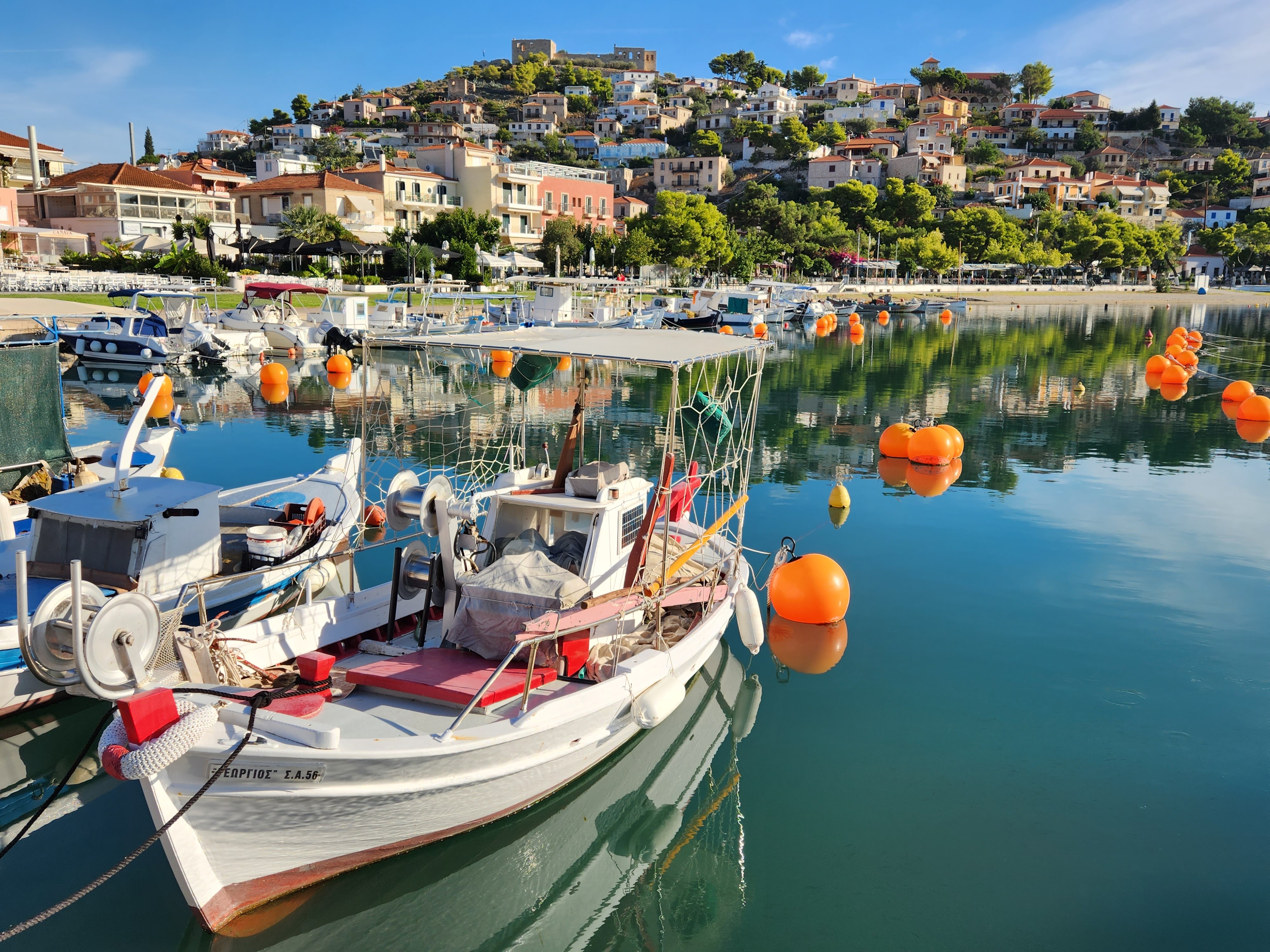
At first blush it would seem preposterous that I would return to Greece to go sailing with Kosta. As I recall from my first (and only) sailing expedition with him, five years ago, the cabins were tight and the bathrooms were tighter still (use your imagination). On the other hand, what a fantastic opportunity to visit so many ports without having to unpack and repack my luggage at each stop as one has to do on a road trip. My last adventure with Kosta was for five days, so I doubled down and suggested that we sail this year for ten. I invited some others to join in and before I knew it (months later), we were all aboard, meeting the sailboat in Poros, a most lively town on a large island about an hour away by "fast ferry" from Piraeus, the famous port that serves Athens.


Kosta's sailboat, the Kime, which means Wave, in Greek, is a 38-foot catamaran with four cabins below deck. Each cabin has a double bed, some shelves and a tiny porthole which is more for air ventilation than for peering out. In fact, I have to admit now, that it is spacious enough if you are solo, and as long as you only use the cabin for sleeping and nothing else. Back upstairs, there are two large areas for sitting or eating on deck, one inside which is practical if it is raining or cold (not often the case in Greece), and one outside which fortunately is covered by a bimini to keep ourselves from broiling under the very hot Greek sun.


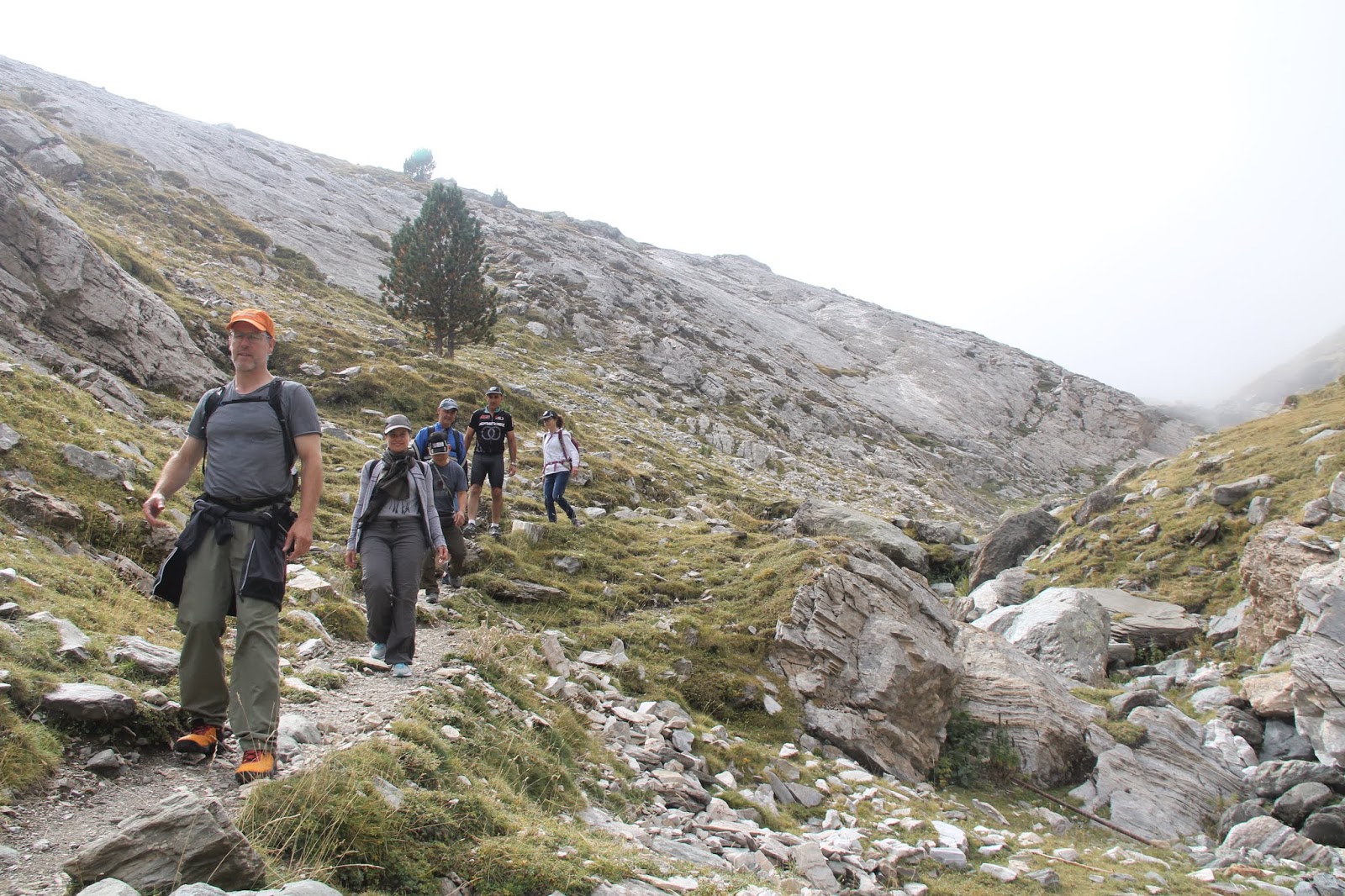
One of the advantages of sailing with Kosta is that he is as active as I am. At nearly every port that we docked, we either rented bikes or hiked up a nearby mountain, usually in the afternoons. One memorable hike was near Astros, a charming town, four kilometers walk from the marina. The entire uphill portion of the 14-km hike was on a dry creek bed. It was rather steep, about 900 metres up over 6 km (this calculates out to 150 metres elevation gain -- a 45-storey building's worth --  for each km walked). The creek bed, at the bottpm of a canyon with nearly vertical walls up to the ridges high above, was strewn with huge boulders, mostly bunched up in cascades to form huge obstacles, each about 10 - 20 feet high, between short strectches of flat hiking. These cliff-like rocky structures transformed this climb into one of my best hiking experiences. It was loads of fun scrambling up the rock faces, often at a faster pace than simply walking. It reminded me that I need to return to rock climbing again after the long lull caused by that spooky pandemic.


It was a typical Greek scorching hot day, although mercifully a couple of degrees less extreme in the mountains than in town below. The weather called for short pants. The only downside were the hundreds of prickly and thorny small bushes that reached out from the edges of the trail or from between the rocks that we were scaling which frequently scratched my legs. You know that you want to avoid these nuisances as many of the scratches drew blood!


Once we eventually reached the summit, a two-km walk on top of this mountain range followed, between grazing herds of bleating goats and sheep. Before long it was time to follow the trail back down to Astros. Nobody warned us that we were about to walk down the face of a 2,500-foot cliff. If Kosta hadn't promised us that he had done this once before, I would have bet a year's pay that only mountain goats and suicidal burros would venture down the narrow path etched into the cliff face. If you look at the photo below you will be hard-pressed to even imagine, let alone actually see, a path down from the summit, switching back from left to right and right to left along its descent. It was exhilirating. It was exciting. And it is unforgettable. Now I long to find more such hikes and simply skip the casual ones, starting today.


After a few days of sailing in the Mediterranean Sea and the Argolic Gulf, I more fully appreciated the freedom that sailors enjoy: unlike on the restrictive, crowded one-dimensional terrestrial highways, at sea we are free to sail in two dimensions, in any direction on its surface, and at any speed with hardly any concern for traffic. When it gets very hot, we simply find a bay, drop the anchor and dive off the boat for a swim. We did this every day, taking advantage of the warm, clear blue waters and regularly swam about 500 metres to a beach where we chatted, skipped stones along the water's surface and then swam back to our sailboat. A kilometer swim each day in the healing salt water is likely more healthy than jogging or weight training. With perhaps only an exception or two in decades, I hadn't skipped stones since I was very young and the joy of (again) perfecting the art quickly brought back to mind my fondest childhood memories of summers on Nantasket Beach, on the South Shore of Boston, where I "grew up" on the Atlantic Ocean. 


In case you haven't inferred, each of these beaches is deserted as they are inaccessible by car. At times the bays where we weighed anchor had other sailboats parked as well, however we were usually the only swimmers. It is cool to be able to see clearly 20 meters down to the seabed but I suppose it may be scary for most people to swim in such deep water. I was wondering if maybe it's not the depth, however, but the fear of scary marine monsters that may be lurking below, waiting for their chance to snack on an unsuspecting human above.


Did you notice that I referred to the Mediterranean as healing. I am uncertain how well documented the healing powers of salt water are in the medical literature, however, I am convinced that a daily swim in salt water will cure all dermatological problems. Pimples gone, dry skin no longer, toenail fungus healed, itches and scratches disappeared. If you forgot that I revealed to you how my legs got scratched up the day before while hiking, my legs did remember for me: each scratch was burning in the salt water, feeling as though razor blades were maliciously cutting up my legs. I imagine that this is the first symptom of speedy healing and so, in my own mind, I transform the discomfort of a thousand cuts into little pleasures. These are some of the reasons why I always imagined that I would return to my childhood summers by living again on the sea, once retired, somewhere in the world. At least for part of the year. This is a work in process, of course, and this season's progress is marked by ten days of sailing in Greece.


Naturally, one of the benefits of living on the seashore again will be a visit from you!

Barry, retired but not yet retarded 😂

Friday, June 24, 2022

Postcard from Sicily - postmarked 09 June 2022

This past week I experienced first-hand the meaning of the saying, "What doesn't kill you makes you stronger!" I am fairly certain that this wasn't my first such experience however it so very easy to forget yesterday's suffering while enjoying today's pleasures.


The first day of a week's cycling in Sicily greeted us all with very hot temperatures of 30C at 9am, climbing to a steaming 36C by mid-morning. Ouch!

Three days previously, to help overcome jet lag, we spent our first day abroad onboard a privately chartered sailboat. The hot sun broiling us from above was countered by the cooler sea breeze blowing all day from one side or the other. Cold drinks, lots of inactivity punctuated by a refreshing swim in the 200-foot deep Mediterranean waters, gave us good reasons for not realizing that it was actually scorching hot.


The next morning , we took a bus to the base of Mount Etna. There, at over 1,000 metres ASL, we had effectively left the high heat below. We had been advised weeks before to wear long pants and to take a jacket as we should have expected temperatures as low as 5C near the summit. However, on account of the heat wave blanketing all of Italy, it never got cooler than about 20C. Black lava covers the entire mountain, some of it is fresh from April's eruption, while the greater majority is left over from past eruptions. Etna is still active today: When hiking closer to the summit I could hear the mountain rumbling continuously as the smoke and steam belch from the crater at the peak. The top 1,000 metres is off limits to hikers due to the high risk of another volcanic eruption without warning.


The landscape looks exactly like images of the moon's surface that we've all seen many times by now, the only difference being the colour. I reached about 2,400 metres elevation when hiking up. Here and there along the slopes are smaller volcanos from earlier eruptions. Many are too steep to climb down into, or up onto, but some others provide a safe access. While standing at the bottom of one of these smaller extinct volcanos, everything is silent. The sounds made by Etna pass overhead.

Here's a cool fact: there are glaciers buried everywhere beneath our hiking boots. In different places, due to the shifting ground, parts of some glaciers are forced to the surface. You may see hot volcanic steam or smoke coming out of the ground a few metres to one side, while there is snow exposed on the other side.

We started our cycling week inland in the mountains, in Caltagirone. Every town we cycled through, or spent the night in, is special, with its unique arrangement of narrow, black (think lava), stone streets and various restaurants, cafés and shops lining them. Our first day of cycling was planned to be 65 km in length with 1,200 metres of net elevation gain. If you aren't clear what this means, let me explain: On flat ground, my group can ride 100 km without a problem. Once you mix in some climbing, it's wise to reduce the distance in proportion. Normally, our trajectory would be considered challenging but doable. However, with the temperatures at 36C starting at 11am, little breeze if any, and a clear cloudless sky, we suddenly have all the ingredients for heat stroke!


In these conditions, it is imperative to drink about a litre of water per hour, even if not feeling thirsty. If your lips or mouth are dry, you need to drink regardless of thirst. Even so, the day was grueling, if not tortuous. On the one hand, the stunning views out over the panoramic valleys of mostly dry farmland (must be between growing seasons now), the mountains in the distance, the narrow stone wall-lined roads nearly always void of cars, and on the other hand, the extreme heat, our relentless thirst and fatigue, it was often confusing to know whether to feel elated or exhausted. Our climbing speeds were most often embarrassingly slow, 7 or 8 km/hr, on account of being overburdened from the unrelenting heat and broiling sun. Shade stops became the norm, every half hour or so.


Even with all the precautions, two cyclists in my group suffered from heat stroke, became delirious (in my opinion) but insisted on finishing the ride, whatever it took: stopping often, walking the bike whenever going uphill, keeping the speed and effort low. I frankly feared for their health and safety, but was sadly unable to persuade them to abandon their first day's ride. Happily, they both arrived intact, two hours after the rest of us, at our next stop, in Palazzolo. Most of us felt completely normal again after a rest and a cool shower, allowing us to enjoy the town's sights and a well-deserved dinner and cold beer al fresco.


Wash, rinse, repeat. Seven days and evenings of cycling, novelty, surprises and the occasional serendipitous moment. The perfect formula for exploring eastern Sicily! Stay tuned for more Sicilian adventures :)

Barry

Saturday, October 2, 2021

Postcard from the OlhĂŁo - Postmarked 28 September 2021


"It seemed like a good idea at the time!" I had been overheard saying later in the day.

Earlier in the day, things were progressing swimmingly! I took a train from my home base in OlhĂŁo to Vila Real de San Antonio, the last Portuguese town before the border with Spain. As soon as I step onto a train, it feels as if I am Marco Polo, off to discover another part of the world. And so I was about to do just that!

Speaking of OlhĂŁo, I've been living here for two weeks. It's a beautiful tourist spot with tons of old world restaurants and cafes, nestled along meandering, cobblestone alleys, mixed in with a handful of more modern shops and boutiques. The restaurants' tables spill out onto the narrow alleyways, filling the air with delicious aromas and lots of Portuguese chit chat. The summer rush of tourists, sun worshippers and riff raff have cleared out by mid-September, leaving a pleasant mix of locals, regulars, and the odd wanderer. Did you know that all of the many kilometers of sidewalks here are laid down by hand, piece by piece, made up of millions of off-white coloured fragments of more-or-less square-shaped flat stone tiles? The sidewalks are therefore consistently uneven, making it interesting to simply go for a stroll. I stumble at least once every few minutes of walking. I think this is why I am not the only one who has decided to walk on the road, just a few inches over from the sidewalk! Worse, the sidewalks are not limited to pedestrians: Bikes, scooters, motorcycles and sometimes even cars treat the sidewalks as their own ticket to freedom, to be used whenever practical so pedestrians must simply dodge the many moving and parked obstacles.

I cycled the first ten kms of today's 80 km ride out of Vila Real, heading west, through a nature reserve which I admit was spectacular. I saw some hundreds of flamingos in the marshes, not quite as pink as the plastic ones in your neighbour's front yard. Still, they are rather majestic the way the stand around on one leg and chat with one another, oblivious to their amazing pink plumage. In fact, these flamingos become shockingly pink when they fly -- this is the real eye candy.

No, the fun started, when the digital navigator on my phone directed me onto a marshy area ten kms beyond the nature reserve's end. There are a lot of marshes along at least half the length of the Algarve, so I wasn't too concerned. It was mostly packed dirt, ochre in colour with lots of bushes and cactus growing all over the place. I saw hundreds of crabs, mostly all having a white stripe on one claw. They'd very quickly scurry away when sensing my presence, crawling sideways of course, before finding their subterranean homes and then dropping down inside them. About 100 km of the Algarve coastline, OlhĂŁo included, is protected by barrier islands. The waters between the coast and these islands are known as the Ria Formosa. Much of this area is mostly underwater at high tide, and half of it dry at low tide. It was low tide at the time so I was able to follow the supposed route that my cell phone application was indicating. It seemed like a good idea at the time... though it was then that I began considering that I was possibly no longer on a bike trail at all.

Soon enough, pedaling through the sandy marsh and shallow pools of water gave way to pedaling slightly uphill on what became a cliffside trail, more likely a trail for hikers, not cyclists. I quickly became a hiker, too, and dismounted my bicycle as riding a bike on such a narrow trail had become risky business: one slip to the left meant tumbling down a hundred feet to a hard landing below. 

Given the littoral geography, Olhão's beach fanatics have to take a short ferry ride over to the nearest barrier island, Culatra Island, which actually has a small permanent community with its own little school, some makeshift cafés and beachside restaurants. The streets that the houses are set on, are really just walking paths as there are nearly no vehicles to be seen. There is a thin layer of sand everywhere underfoot when walking about. Robinson Crusoe would feel right at home! The island's entire perimeter is covered in fine, beige sand, no rocks or pebbles anywhere. The south side of the island is exposed directly to the Atlantic Ocean where the water is cool and the waves are wonderful. However on the north side, facing Olhão, the water belongs technically to the Ria Formosa, and is always warmer.

Pushing forward, I navigate the cliffs and end up back on a beach. But very soon arrive at a small river that must be crossed. The alternative is to follow yet another dirt terra cotta-coloured path uphill a bit to hopefully intersect a real road which likely had a bridge to cross this river.


Well, in for a penny, in for a pound, and I am now crossing the river by jumping from stone to stone all the while carrying my bike. The presumed path on the far side appears to be camouflaged as all the gaps between the tightly spaced thorny bushes and prickly cactus look like paths to me. There is no apparent way to proceed and after ten minutes of being prickled from all sides, but barely making any forward movement, I finally conclude that it's time to retrace my steps. Dragging my bike back through the dense brush took twice as long as I couldn't find my way! A half hour later I am back at the little river. But guess what? The tide has been coming in and the river was flowing backwards, upstream! The water deeper, the river wider, the jumping stones are submerged now, invisible. No challenge is too great and off come my shoes so I can wade across to the side I started from.


If you think I am stressed out or frustrated, think again. The fun is just beginning... I climb the aforementioned trail, jump on my bike and start pedaling, remember I am on a mountain bike! It feels very difficult to move forward. Maybe I am stressed and fatigued after all!? Wrong again: the cause is a flat tire, likely due to a cactus thorn that pierced right through my thick treaded tires! When I finally exit the dirt path, I am miles from a bike repair shop on a quiet road, under a broiling hot mid-day sun, running low on water, and now must either walk my bike for at least an hour or sit down and cry. What would Marco Polo do?

To find out... stay tuned!

Barry the wanderer.

Sunday, October 20, 2019

Postcard from the Costa Brava - Postmarked 08 October 2019


Consider this: you are outside and it is completely silent, no wind not even a breeze. Unearthly sensation. Silence.
The sun is just now rising at the horizon far away to the east. When you look down, you get an eerie feeling in the pit of your stomach... because you are 3,000 feet above the ground, nothing below but space, you are floating freely in a basket suspended below a massive hot air balloon!


The feeling is magical, as you and the balloon are indeed floating horizontally about 20 km/hr, exactly at the speed of the wind. Thus the air is perfectly still inside the basket as you drift along within the current of wind.
If you think that this feeling is no different from staring out of an airplane window midflight, think again. Firstly, you are outside -- there is no window! And, you can very distinctly see all the details below: the trees that make up the forest, the streets, houses and people that comprise the towns, the farms, the cows and even the chickens. You can even hear the cows mooing, the roosters cock-a-doodling, and especially the dogs barking. It seems the dogs get spooked by us above and respond as all mutts do.
As exciting as the flight is, it pales in comparison with landing this huge contraption! First a large field or meadow must be identified ahead amongst the forests and farms, altitude lost just so, structures, power and telephone lines avoided at all costs, and finally plenty of margin for error as the actual point of impact can only be estimated. And... surprise... the basket will bounce, become airborne again and bounce again a few metres downwind. Depending on the pilot's skills, there may be two or three bounces before we stay put. Once the immense balloon is deflated and rolled up, out comes the obligatory bottle of champagne, glasses are filled, clinked together and then quickly emptied!

The network of hiking trails in this part of Spain is impressive. The trails are poorly marked, unfortunately typical almost everywhere round the world, however intersecting trails here are well identified with signposts giving the distances in each direction to the next towns, as well as the "names" of all the trails. What has impressed me is that there are so many trails criss-crossing Spain -- some of them are hundreds of kilometers long -- that these identifying signposts are very helpful. The Grande Route, or GR trails cross all of Europe and most are thousands of kilometers long. We drove up to a tiny town in the Spanish Pyrenees, Queralbs, which was literally the end of the road. Then took a cog railway 6 km uphill to, of all things, a ski resort. Naturally, there was no one skiing yet, but still there were people about everywhere to enjoy the views, mountain air, and excitement of being at the end of the line. We started on a hike uphill into the Nuria Valley, a spectacular range of Pyrenees' foothills, with enough criss-crossing trails that we could adjust our course to allow for more or less time available. Missing the last train downhill would have necessitated an additional 8 km of trekking back down. Still being a little jet-lagged, we elected to avoid the extra stroll.


A cog railway is one whereby a column of teeth is bolted into the ground midway between the two steel rails for the entire length of the track. An electric motor (or likely two) turns a gear under the car which exactly matches the stationary teeth. And so the railway cars climb up or down the steep mountain. There is no chance of slippage as when steel wheels are pulling the cars on steel rails. As I mentioned, the hiking here is magnificent. Being above the tree line, the entire hike affords incredible views of the mountains, varying with each twist and turn in the contours of our path. With the additional chance arrival of fog here and there, now and then, our views often arrived at random intervals, revealing awesome sights to the faraway peaks. Hiking uphill in nature has been proven to be beneficial to both our mental and physical health, but I can now add one additional collateral advantage: it cuts a couple of days off of jet lag recovery!

The raison d'ĂȘtre of my adventure is about to start: seven days and 500 km of cycling starting from the idyllic French port village of Banyuls-sur-Mer, then south across the border and along the Spanish Costa Brava, ultimately to Barcelona. In summertime, thousands of tourists flock to Banyuls-sur-Mer to spend a week or two. Aside from its beautiful Mediterranean beach, the many local wineries and the charming outdoor seaside restaurants, the town is the starting point of the trans-Pyrenees Grande Route, the GR10, which ends at the Atlantic Ocean, 875 km to the west. It boasts 48,000 m of elevation gain over its route! As probably half of those brave GR10 backpackers start at the other end, we can see small, sometimes confused groups of tired, dusty, but excited hikers arriving in Banyuls-sur-Mer at the very end of their month-long hiking quest! Alas, our stay here is but for 24 hours as we collect our bicycles and start out in the morning. The first two days witness us traversing the Pyrenees, too (but from north to south) with lots of long steady and tiring uphill cycling, always followed by exhilarating stretches downhill at speeds that even the cars cannot match, thanks to the many tight curves that favour us cyclists. The photo opportunities are unique and numerous so we stop often to capture the sea views framed by the craggy shorelines, the waves smashing against the rocks below and in the distance. Often a spray of sunlight pierces the clouds like the spokes on our bicycles, radiating down to Earth, as our first day of riding is thankfully not blue sky. I say this because all the following days of riding and beyond greet us with exceptional500cloudless days and a broiling hot sun, thoroughly baking us below. Applying sunscreen twice a day turns out to be insufficient as my arms and legs evidently require even more protection from the strong Catalunyan sun!


I have written you previously about the sheer pleasure and joy of leaving one seaside village in the morning on a bicycle, riding into the mountains passing through random picturesque towns, stopping in one of them for a tasty lunch outdoors, then continuing on back to the coast, again cycling through one amazing port village to another similar village before ultimately, 80 km later, arriving at our destination. I would be ecstatic to spend a few days visiting any one of these villages, it is almost sad to say hello and goodbye so quickly as we cycle on. At home, an 80 km ride takes between three and four hours, including the odd stop for a snack. Over here, the same distance invariably includes so many photo stops plus the deserved lunch that even as we depart at 9:30am each morning, we usually arrive at the day's destination only after 4pm.


Still, plenty of daylight left to head to the beach for a refreshing swim in the cool salty waters and a stroll through the Old Town before returning to our hotel to prepare for the evening's tour of castles, stores and restaurants. When we say Old Town at home, we think of buildings and streets dating back a couple of hundred years. In Catalunya, or anywhere in Europe, the Old Town's stores, apartments and churches date back 500 years and more. The streets are narrow, winding, often made of stone. I find every one of them, mesmerizing in its unique charm. I suppose if ever I move to Europe, I will choose to live in the Old Town neighbourhood of whatever city attracts me.

I am presently finalizing this postcard to you from my comfortable living room back home and am already longing for my next adventure overseas!

Wednesday, March 20, 2019

Postcard from Lyon - postmarked 13 March 2019


I last wrote you from Lyon over a decade ago. France's second largest city -- some say its third largest -- hasn't changed much in 200 years let alone during the last decade. I remember then recounting to you about this amazing experience I had. With the tap of an icon on his phone, my French friend, Christophe, liberated two public bicycles from their stands, and he treated me to a two-hour bicycle tour of his town. I remember writing how I must inform Montreal's mayor about this bicycle sharing concept. True to Canadian form, the city invested, created and mismanaged Bixi until it went bankrupt. But Lyon is not resting on its laurels. Once again I am charmed by the latest: there are little electric scooters left about everywhere. I really do mean everywhere. On every block, in every park, at random places there is a scooter perched on its teeny kickstand. Anybody with the app simply scans the QR code affixed to its handlebar, steps on the tiny platform, accelerator on the left handle and brake on the right, and scoots away, always standing while riding. They are such popular means of transportation that you can see somebody scootering this way and that every minute or two, anywhere you may be, day and night. Some of the more brave, or more stupid, not sure which, can be seen weaving around in traffic at 30+ km/hr sans helmet, rather than sticking to the bike lanes and the usual cycling speeds.


In spite of the charm that this city offers, there is one aspect of this year's version of Lyon that I find troubling. I have never had to breathe in so much side smoke as here. It seems that every second Lyonais is a smoker. A chain smoker, likely. As France has finally caught up with the rest of the world and banned smoking in restaurants and cafés, smokers here have to double down on their addiction by puffing away on every city street and sidewalk. In other words, I am nearly always downwind of somebody's cigarette smoke. By design, I normally refrain from reporting on negative experiences however I believe I am marked now, and cannot shake this trauma from my thoughts. I am racking my brain for a solution which I would gladly pitch to the local authorities.

Thinking back to a time in my early 20's when I first visited France, I note another big change in French culture. Back then, most everybody bought a fresh baguette at the bakery, tasty cheese at the fromagerie, meat at the boucherie, and voilà lunch was ready to be eaten during a break from work. These days, the average Lyonais will stop instead at a local café, eat a ready-made sandwich, have a coffee and cigarette, while seated outside regardless of the weather. Twice the price and half as healthy since the sandwiches are mostly bread and mayonnaise. I know this firsthand as I had to eat one to learn about their popularity. It seems to me that the culture here is in decline. Healthy food appears to be out of financial reach of the average French citizen. Unless they make wine cheaper than water, as the Russians have engineered with vodka pricing, I understand why the population continues protesting in Lyon, Paris and elsewhere every Saturday -- you can Google gilets jaunes for the latest news. When the day comes that a single banana costs 60 cents at home, too, we may yet see Canadians marching in the streets demanding affordable groceries.

Every place you visit invariably has its pros and cons. One lovely aspect of Lyon is its nightlife. Sprinkled around town are concentrations of clubs, lounges and bars. The weather in March is already warm so many of the revelers are seated or standing outside in front, the easier to smoke for sure. Vieux Lyon is one of my favourite areas. I am the first to admit that, like Old Montreal, it is somewhat touristy, although less so at night. Unlike Old Montreal, however, Vieux Lyon is very old. The streets are uneven, narrow, nowhere even close to being parallel or perpendicular, laid down as cobblestone. The buildings are 300, 400 years old, two or three stories high, mostly. What I find appealing is that the shops, bars, etc., are inside these antique structures. Normally, there are multiple rooms, connected at odd junctures, ancient brick walls, thick wooden beams holding up the low ceilings. Depending on the decor, it all comes together as being one establishment. Easy-going the Lyonais are, no bartender or shopkeeper is rushing you to buy something. It's rather a pleasure just to breathe it all in, relax, and enjoy the evening over strong European beer or a renowned French wine.


Here's to us all sitting back to relax sometimes, no matter where in the world we may be.

Barry from Lyon

Sunday, October 21, 2018

Postcard from Puglia - postmarked 03 October 2018


Although I had been daydreaming about, and subsequently planning a group cycling tour of Puglia -- this is the southeast region of Italy, or "the heel of the boot" -- for almost six months, I am hesitant to admit that what has had me amped up was the high-altitude high-speed zipline experience that I had also booked for the very first day after the week of cycling.
And it was a bit fortuitous that it would be realizable at all as the zipline is only operational on weekends after mid-September. Our cycling week ended on Saturday with a celebratory dinner that same evening in the historic old town of Polignano a Mare, a fascinating port city on the Adriatic coast. Every old town shares many similar, arguably romantic attributes: very narrow, often twisting streets, not paved but assembled from stone, even sometimes from marble in fact, laid centuries ago when not yet invented cars could not exert any design influence on their layout; ancient stone buildings now housing resplendent restaurants, cafés and boutiques; and of course a church or two, often magnificent in stature replete with the most detailed artwork adorning their vaulted ceilings and brilliant stained glass windows punctuating their walls, but as well other churches rather understated lacking any splendor at all, out of favour perhaps. When a town is considered historic in Italy you can be sure that most of its buildings were constructed four or five hundred years ago, and the remainder even older and still standing, too, in contrast to our much newer buildings and roads at home in continual need of repair or replacement. I find it frankly amazing that we often enjoyed our dinners in restaurants that were built even before the concept of a restaurant came into being, where the original centuries old wooden beams still hold up the ceiling; where the electric wiring had to be added to the structure only after electricity had been invented and become available so the hall could be illuminated for us all to see our tasty pizzas, risottos, pastas and our friends' smiling faces, too; where the plumbing needed in a modern kitchen (and lavatory) had also to be added decades ago once this became common practice, too

As we were cycling outside of the summer high-season, we always had good luck in being seated all ten of us at one table, hastily arranged from smaller tables by the waitstaff eager for the business. Somewhat bittersweet our last dinner was as we all knew well that Sunday would not be another glorious day of cycling, no longer were random surprises awaiting us as we rode our daily 90 km track along the coast, at least once a day through a zombie village where I imagine several thousand summer residents had completely filled the town but a month earlier, crowded the beaches with reverie, swelled the cafés and bars their coffees and beers noisily consumed, emptied the stores of beach paraphernalia, sunscreen and bathing attire, only to be totally deserted by early September, leaving ghost cars and bicycles behind, silent and motionless; windrifts of sand blown in from the beach accumulating at random corners and on streets (risky business for a cyclist!) possibly to be swept away by next summer's returning residents. My first zombie village experience made me imagine the aftermath of a neutron bomb, where supposedly all life is obliterated yet no harm befalls the homes and other structures. At first I decided that it must be siesta time, that period from 2pm to 6pm when even today, in the high-tech 21st century that we all inhabit, all commerce ceases so that workers could return home for a home-cooked pasta meal and a nap. But no, a siesta it is not. The houses are closed up tight, their windows shuttered and the town's population drops to zero! I half-expected to see tumbleweeds blowing through the deserted streets. I suppose tumbleweeds don't blow outside of Arizona very often. Or is it New Mexico?

Other villages, the larger ones, remain alive and vibrant all year long as one might expect. Of course it was in these towns that we spent our evenings. The one town I must reveal to you as being perhaps the most amazing is Matera, km 0 for us out of 525 km ultimately cycled over six days. I fear that I will spoil the surprise that awaited me by sharing this, however for you who will likely never visit, read on: the Old Town of Matera, much like all the others, is accessed by passing through ancient gates, under giant stone archways, leaving behind modern buildings and paved streets for the charm of all that is antique. But there's more: the center of Old Town Matera appears to be dug out of the surrounding city, a hole about 400 metres in diameter. It is nestled deep within and down below. Steep stone staircases cut into the walls of this depression allow us to descend to its very centre. I have never seen a city with a hole in its center, and in this hole another city is built, with homes clinging to the steep walls leading down surrounding the tumultuous cacophony of commerce and restaurants and cafés at the bottom. Close your eyes for even a moment and imagine old square stone houses with their ubiquitous orange-coloured clay roofs 360 degrees around the edge of a bowl 400 metres across, and down the sides of this bowl, more houses, all the way to the bottom. Add this town to your bucket list, it is unique for other reasons, too, for you to discover without my guidance.

The celebratory dinner behind me -- as tasty as any dinner in Italy -- my next challenge was to get my ass an hour north to Bari, Puglia's largest and only city where a car can be rented. Two cycling friends and I were finally, comfortably seated in a rented Panda en route to Castelmezzano, one of the ten most beautiful mountain villages in the world, it has been written. Google it and you will see that I kid you not. An hour of highway followed by ninety minutes of narrow, winding roads, a few wrong turns thrown in for good measure, slowly climbing mountainsides as we closed in on our mountaintop destination. Castelmezzano's buildings are built into the mountainside with barely room for anything motorized to get through beyond the village's entrance. So parking our car along its access road's shoulder is normal practice and dragging our luggage 500 metres uphill along pedestrian passageways to our B+B is also normal, drawing no stares from townsfolk. One really has to see this village to understand how it justly earned its reputation for amazement. The first view of it from a bend in the approaching road -- there is only one way in -- left me speechless. I admit that finding myself speechless is a rare treat, a feeling that I relish. The townspeople live in houses basically uphill and downhill from each other. A deep valley separates this village from its neighbour, Pietrapertosa, which is similarly built on top of its own mountain, two kms south. A few years ago somebody decided to build not one, but two ziplines connecting the two mountain villages. One zipline zips downhill in one direction from the top of one mountain, and the other returns the customer back to his or her starting point from the top of the other. Did I forget to mention that we zip along at over 100 km/hr? Yep, you read this correctly, over 100 km/hr on a zipline which is more than 1,500 feet above the valley floor below!! I knew these statistics when I reserved our 4:30pm time slot three months ago and it has been weighing on my mind until this Sunday when we ultimately arrive in Castelmezzano. Not as you might guess on my mind due to trepidation but to anticipation of the expected euphoria to come. I am certain that the 100 km/hr speed metric had not been what was exciting me all this time, but rather it was the altitude: zipping 1,500 feet above the trees below me, in effect flying like an eagle, being secured only by a cable above me and a couple of hooks. Unimaginable. A shuttle takes us up a narrow road, one switchback after another and deposits us at a footpath above the village. Anticipation grows further, as I have roped my two brave cycling friends into joining me, and we walk uphill another 25 minutes, chatting nervously about who will go first, who will go last and who will change his mind and bail, to arrive at the mountain's peak and the starting point. Like most thrills (and fears) in life, the very thought of what follows can be more terrifying than the event itself. Not so in this situation. The excitement continues to build for the experience to come. I slip into a harness and tighten it, don a helmet, and allow the attendant to clip me to the cable. I remain uncertain as to the utility of the helmet however it occurs to me only now that I could slam into a bird at full speed. I am asked to lie horizontally suspended and a second clip is attached to the cable, I grab the straps behind my back to secure my arms and next a little sail is fitted between my back and the roller above which will prevent me from gaining too much speed as it catches the wind and acts as a brake. After months of expectancy a catch is released and I accelerate horizontally into space somewhat downhill faster and faster, the wind rushing towards me, my eyes start to tear -- from joy or from the wind I do not know. I look left, right and down and I am in denial that this is real. To be frank with you, it is surreal. Picture me: I am flying! I am an eagle. A very fast eagle!

This I know: a huge thrill it was, it was over too quickly (about 75 seconds) and my Strava app logged me at 103 km/hr for nearly the whole time. Add Castelmezzano to your bucket list. You can thank me later.

Cycling/zipping Barry of Puglia